
.avif)
The MIT AI Risk Initiative (AIRI) provides authoritative data and frameworks to help decision-makers across the AI ecosystem identify, prioritize, and manage risks from AI.
We are based at MIT FutureTech, a joint initiative of the Institute of the Digital Economy and MIT CSAIL at the Massachusetts Institute of Technology that studies the technical and economic foundations of progress in computing. We work closely with researchers at The University of Queensland and a wide network of experts across government, industry, and academia.
Our work is free to use and openly available, and most of our outputs are published under a CC BY 4.0 licence.
AI risk is a large and fast-moving subject. Understanding it means keeping track of what can go wrong, who is affected, how organizations are responding, and where the gaps are. No single dataset captures all of this, so we maintain several connected workstreams, each answering a different question.
We publish this work as open databases and interactive tools, alongside peer-reviewed papers, reports, and regular updates. Our resources are used by policymakers, companies, and researchers around the world, and are cited in international assessments such as the International AI Safety Report.
Follow our work. Subscribe to our newsletter and follow us on LinkedIn to keep up with new data, tools, and findings.
We build open, shared infrastructure for understanding and managing risks from AI.
AI is being developed and deployed faster than our collective ability to understand its risks. Companies and governments are deploying powerful AI systems in high-stakes settings, from healthcare and finance to national security, and the potential harms range from discrimination and privacy loss to systemic and catastrophic risks.
The knowledge needed to manage many of these risks exists, but it is fragmented: scattered across hundreds of separate frameworks, buried in academic papers and technical reports, lacking common language. Decision-makers are asked to act without a shared basis for seeing the full picture, agreeing on what matters most, or finding the real gaps.
The choices ahead, about how powerful AI is developed, deployed, and regulated, are contested and high-stakes. They will be resolved through argument. Our role is to give those arguments a common foundation of evidence. Our flagship output, the AI Risk Repository, synthesizes 1700+ risks from 70+ frameworks into a common taxonomy. Other workstreams prioritize risks, identify mitigations, map company and government responses, and track incidents of AI harm.
We cover the full range of documented risks, and we direct particular attention to the risks with the largest potential for harm. We publish what the evidence shows. We succeed when policymakers, companies, and researchers act on shared evidence, and the cumulative effect is better AI governance and a safer path for powerful AI.
In the media
Our work has been widely referenced by decision-makers and covered by the media. Below is a short selection of notable coverage, illustrating the research's influence in the AI discourse.

What the Numbers Show About AI's Harms

MIT researchers release a repository of AI risks

AI risks are everywhere, and now MIT is adding them all to one database

MIT releases comprehensive database of AI risks

A new public database lists all the ways AI could go wrong

Researchers Have Ranked AI Models Based on Risk, and Found a Wild Range

MIT Launches the First-Ever Comprehensive Database of A.I. Risks
Our datasets and frameworks are free to use and openly available. Across the AI ecosystem, different groups draw on them to identify, prioritize, and manage risks from AI.
Policymakers and governments use our work to map the risk and policy landscape, inform risk assessments, and as a shared reference for discussing AI risks.
Industry draws on it for internal risk assessments, to understand exposure across the AI value chain, and to build risk taxonomies, controls, and governance frameworks on common foundations.
Researchers, evaluators, and auditors build on our taxonomies to develop new research, evaluations, curricula, and audits, and to find underexplored areas of AI risk.


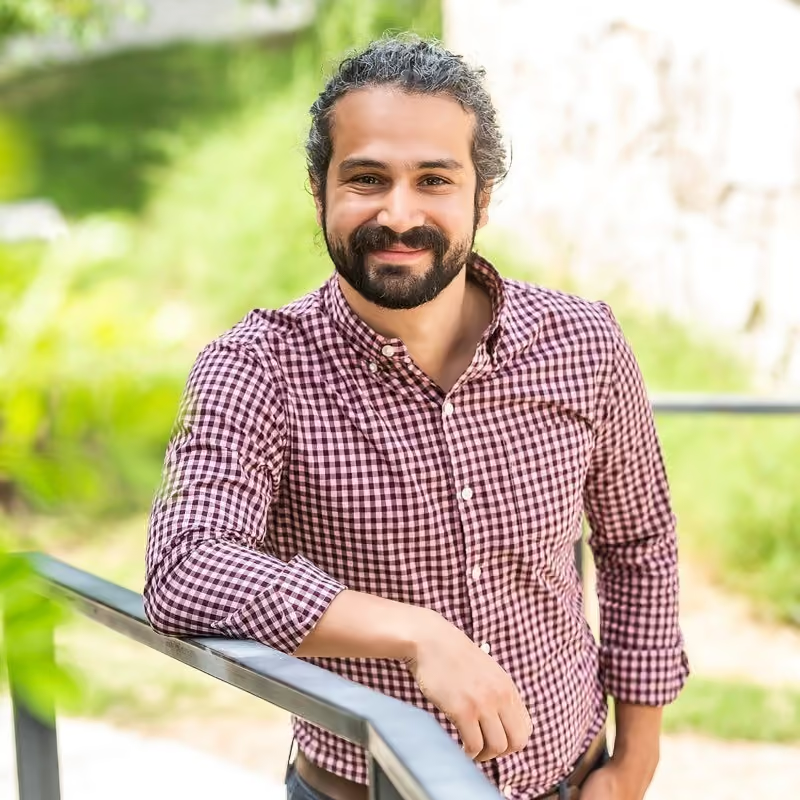
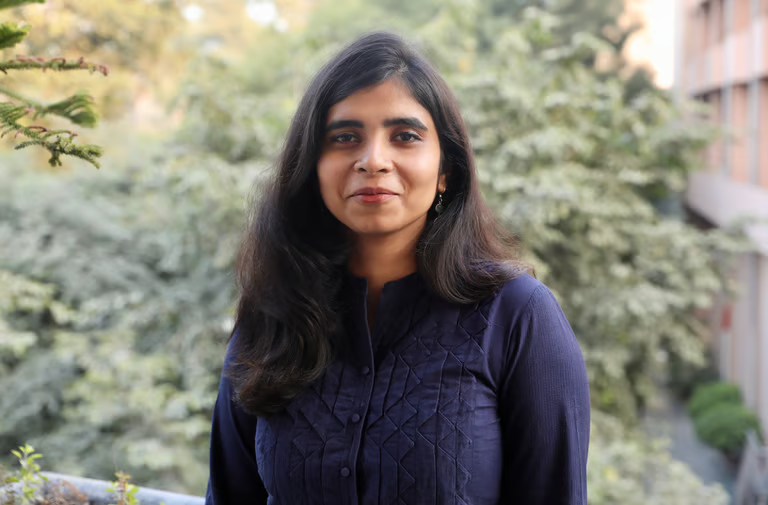


The MIT AI Risk Initiative is led by a core team based at MIT FutureTech and the University of Queensland, working with collaborators, fellows, and students across a range of institutions.

Alexander uses a mix of applied behaviour science and social science methods to understand and address complex challenges, including the governance of artificial intelligence.
Alexander has expertise in implementation science, scale up of effective interventions, group processes, systems thinking, and socio-technical transitions, and has extensive experience as a research consultant and facilitator. He holds a PhD in Social Psychology from The University of Queensland in Australia.

Peter helps to lead the AI Risk Initiative project. He is experienced with a broad range of qualitative and quantitative research techniques, including literature reviews, conceptual papers, interviews, experiments, surveys, and structural equation modelling. He received his PhD in Information Systems from the University of New South Wales in Australia.
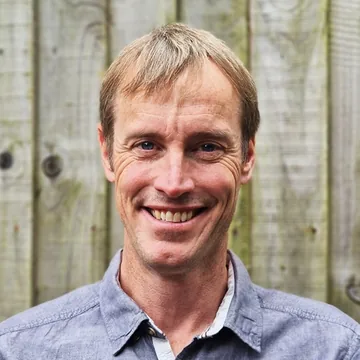
Simon is a Chartered Engineer with over a decade of experience leading Systems Engineering teams in product development and system integration. He is now focused on AI Safety, applying Systems Engineering methodology to the Technical Governance of Artificial Intelligence. He recently completed the 2025 Winter Fellowship at the Centre for the Governance of AI, working on the application of Systems Theoretic Process Analysis (STPA) to frontier AI. He developed and leads the AI Incident Tracker - a classification tool and dashboard to add structure to datasets of reported AI safety incidents, which is now hosted by the MIT AI Risk Repository and its analysis features on AI Incident Database. He co-authored ‘Assessing confidence in frontier AI safety cases’ exploring probabilistic assessment methods and approaches to addressing argument ‘defeaters’.
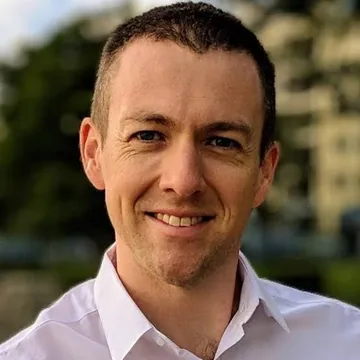
Michael provides methodological expertise and strategic and technical advice for the AI Risk Index. He has a strong background in systematic reviews, Delphi studies, and meta-analyses.

Kun is a behavioural scientist and applied researcher with expertise in quantitative and qualitative research methods for understanding and addressing societal challenges. Previously she was a research fellow and consultant across government and industry in the areas of health, social inclusion, workplace relations, and humanitarian aid. She holds a PhD and Master of Clinical Neuropsychology from the University of Melbourne.
Jessica's work is focused on improving efforts to classify and address risks from Artificial Intelligence. Her previous work includes co-authoring a representative survey of Australians that explored public priorities related to AI development and regulation. Jessica holds a Bachelor of Psychological Sciences (Honours) from the University of Adelaide, Australia.

Robert has a background in AI research, embedded software and systems engineering. He received his Bachelor of Science in Engineering from Harvey Mudd College.

Neil Thompson is the Director of the FutureTech research project at MIT’s Computer Science and Artificial Intelligence Lab and a Principal Investigator at MIT’s Initiative on the Digital Economy.
Previously, he was an Assistant Professor of Innovation and Strategy at the MIT Sloan School of Management, where he co-directed the Experimental Innovation Lab (X-Lab), and a Visiting Professor at the Laboratory for Innovation Science at Harvard. He has advised businesses and government on the future of Moore’s Law, has been on National Academies panels on transformational technologies and scientific reliability, and is part of the Council on Competitiveness’ National Commission on Innovation & Competitiveness Frontiers.
He has a PhD in Business and Public Policy from Berkeley, where he also did Masters degrees in Computer Science and Statistics. He also has a masters in Economics from the London School of Economics, and undergraduate degrees in Physics and International Development. Prior to academia, He worked at organizations such as Lawrence Livermore National Laboratory, Bain and Company, the United Nations, the World Bank, and the Canadian Parliament.
Researchers, advisors, fellows, and students contributing to the Initiative.
Adrian Thinnyun is a Data Research Analyst at Georgetown University’s Center for Security and Emerging Technology (CSET), where he supports the Emerging Technology Observatory (ETO) initiative. He previously completed a yearlong placement with CSET as a Horizon Junior Fellow, overseeing the ETO platform and engaging stakeholders across government, academia, and industry. He holds an MS in Computer Science, specializing in Machine Learning, from the Georgia Institute of Technology, and a BA in Mathematics and Computer Science with minors in Psychology and Japanese from the University of Virginia.
Aileen is studying Math and Computer Science at Wellesley College. At MIT FutureTech, she contributes to the AI Risk Repository and AI Mitigation Taxonomy. She's interested in applying pure mathematics and social theory to work towards AI safety.
Bosco Hung is the Co-Founder of the Oxford Computational Political Science Group (OCPSG), a non-partisan research initiative based at the University of Oxford. Before pursuing an MPhil in International Relations at Oxford, he graduated with a BSc in Politics and International Relations from LSE, where he studied on a full scholarship and wrote his dissertation on machine learning applications to studying narratives about international AI governance.
He was a Fellow at the Future Impact Group and has co-authored research papers on AI safety and governance of advanced AI systems with researchers from the Centre for the Governance of AI (GovAI), OECD.AI, and the Oxford Martin AI Governance Initiative.
He has been interviewed by France 24 and Al Jazeera to provide geopolitical analyses. Previously, he was invited to speak to the European Parliament's Special Committee on the European Democracy Shield Mission to the United Kingdom about disinformation and media literacy.
David Turturean is a senior at MIT, double-majoring in Physics and AI & Decision-Making. His research ranges from accelerating black hole imaging to training neural networks to investigate extreme cosmic objects and communicating the impact of AI on society. David’s broader focus is value-aligned machine learning and technical AI governance.
Mina Narayanan is a Research Analyst at Georgetown University’s Center for Security and Emerging Technology (CSET), where she works on AI governance and safety. Her work focuses on U.S. AI governance, spanning AI standards, risk management practices, and evaluations. Prior to joining CSET, she worked at the U.S. Department of State in the Bureau of Consular Affairs where she monitored developments and prepared correspondence for international child abduction cases. Previously, she leveraged topic modeling to analyze research portfolios at the National Institute of Nursing Research. Mina holds a Bachelor of Software Engineering with a Minor in Political Science from Auburn University and a Master of Science in Public Policy and Management from Carnegie Mellon University.
Peter Wallich is a Senior Research Program Manager at Constellation Institute, where he builds programs to grow the field of technical AI safety research and provides research management to fellows on the Anthropic Fellows Program and the Astra Fellowship. Previously, he held several roles at the UK's Department for Science, Innovation and Technology - most recently as a Senior Risk Advisor at the AI Security Institute (AISI). His work as a civil servant has included engagement with frontier AI labs on voluntary commitments ahead of the UK AI Safety Summit and preparation of briefings for senior government stakeholders on risks from advanced AI systems. Peter recently co-authored 'Position: We Must Proactively Address AI Safety Debt,' arguing that 'AI safety debt' could create substantial risks and should be proactively managed. He holds a BA in Philosophy, Politics and Economics from the University of Oxford.
Sean McGregor is a machine learning safety researcher whose efforts have included launching the AI Incident Database and training edge neural network models for the neural accelerator startup Syntiant. With an applications-centered research program spanning reinforcement learning for wildfire suppression and deep learning for heliophysics, Sean has covered a wide range of safety critical domains. Sean's open source development work has earned media attention in the Atlantic, Der Spiegel, Wired, Venture Beat, Vice, and Time while his technical publications have appeared in a variety of machine learning, HCI, ethics, and application-centered proceedings. Sean holds a Ph.D. in computer science from Oregon State University and is currently the Executive Director for the Responsible AI Collaborative (i.e., the AI Incident Database), co-founder and lead research engineer for averi.org, and lead of the agentic product benchmarking workstream with MLCommons.
Victoria focuses on AI risk governance and AI adoption governance, with an emphasis on the interaction between human decision-making and AI systems. Her work draws on risk assessment methodologies and practices from regulated and safety-critical industries to inform AI safety and governance challenges.
Victoria has experience designing and evaluating risk governance frameworks, including regulatory-facing work. She has a technical background in machine learning and holds bachelor's and master's degrees in applied mathematics and physics, and a master's degree in data science.
Yan is an AI governance researcher and entrepreneur specializing in AI policy and governance. She holds a Master of Public Policy with a specialization in AI governance from the University of California, Berkeley, along with a graduate certificate in Applied Data Analytics.
Yan has contributed strategic insights on technology governance to international organizations and government agencies across multiple jurisdictions, including the U.S. Department of Energy (DOE) and the World Wildlife Fund (WWF). Her work spans regulatory analysis, compliance frameworks, cross-border policy coordination, and the development of governance strategies for emerging AI technologies.
As an entrepreneur, Yan is incubating an AI governance startup through the Berkeley SkyDeck Pad13 program, where she is building tools to translate AI policy into practical and scalable solutions.
Former team members, collaborators, and students.
Alor Sahoo is an MIT senior double majoring in Computer Science and Writing. His research focuses on analyzing public opinion on AI risks, mitigations, and regulatory approaches. Outside of research, he previously interned at Uber as a software engineer and is a SERC Scholar at MIT's Schwarzman College of Computing.
Angelica is an independent AI safety researcher with a particular interest in sociotechnical AI safety. She holds a Master's degree in Data Science from the University of Sydney.
Over the past few months, she has participated in various AI safety programmes and fellowships, including the AI Ethics, Safety and Society (AISES) course by the Centre for AI Safety, EleutherAI Summer of AI Research (SOAR), Supervisory Program for Alignment Research (SPAR), and the Human-Aligned AI Summer School.
She is currently a research fellow for the Mentorship for Alignment Research Students (MARS) programme, where she is working on the "AI Governance Mapping Project" by MIT FutureTech. In addition, she is a research fellow for the Future Impact Group (FIG), where she is working as an affiliate under the MINT Lab with Seth Lazer on evaluating LLM agent normative competence, and with Richard Mallah on researching adversarially credible AI evaluation standards.
Professionally, she has been a data scientist for over five years, working across consulting, insurance, banking and fintech. She is also involved with Women in AI, recently served as an industry partner for the University of Technology Sydney's (UTS) Transdisciplinary School on their Master of Data Science capstone programme, and worked as a Review Editor at the AI Ethics Journal.
Arjun received a bachelor's degree in Computer Science from Williams College and is currently pursuing a Master's in Finance at MIT.
Audrey Lorvo is an MIT senior studying Computer Science, Economics, and Data Science, with a concentration in International Development. She is a Research Assistant at MIT FutureTech, where she contributes to the AI Risk Repository and the AI Risk Index. Her previous research spans economic policy, urban planning, and data science, including contributions to the Organisation for Economic Co-operation and Development (OECD) on place-based policies.
Ben Olsen is Software Engineer supporting research at Future Tech CSAIL MIT. He is also a Masters student at Georgia Institute of Technology, studying applied AI and Machine Learning.
Catherine is studying Computer Science as a Master of Computer and Information Technology student at the University of Pennsylvania. Previously, she earned a BA in Russian and Eurasian Studies at Mount Holyoke College and researched Eurasian free expression issues at PEN America. At MIT FutureTech, she contributes to the review of AI risk mitigations and organizational responses to AI risks.
Clelia Lacarriere is a junior at MIT studying Mathematics and Computer Science, Data Science, and Economics. She is a Research Assistant at MIT FutureTech, where she contributes to the AI Risk Repository and the AI Risk Mitigation Taxonomy. Her previous research spans number theory and political science, and she’s excited to be focusing on AI safety.
Daniela’s work examines how emerging technologies, such as artificial intelligence, shape productivity, economic growth, and development outcomes, as well as the governance frameworks required to support responsible and inclusive technological progress.
She brings over a decade of experience delivering high-impact research and policy insights across academia, international organizations, and the private sector, with prior roles at the International Monetary Fund, Harvard University’s Growth Lab, MIT's Abdul Latif Jameel Poverty Action Lab, and Amazon Web Services. She holds a Master’s degree in International Economics from the Johns Hopkins University School of Advanced International Studies.
Echo combines insights from artificial intelligence, political economy, and social science to tackle complex systems challenges with a focus on policy and emerging technologies.
She brings experience across research, startups, and non-profits, working at the intersection of causal inference, governance, and innovation. Echo has contributed to international political economy research, data-driven advocacy, and AI-based policy simulations. She is currently pursuing a BA in Artificial Intelligence and Political Science at Minerva University.
Elisa is a freshman at MIT studying Computer Science and Mathematics. She is a Research Assistant at MIT FutureTech, where she contributes to the AI Risk Index. Her prior experience spans from research in automated code repair and security patch detection to developing public policy for safe, responsible, and ethical AI.
Emre applies insights from political science and global macroeconomic literature to identify and mitigate risks associated with frontier AI models. He specializes in analyzing international policy dynamics, governance strategies, and their implications for the frontier AI models.
Fatimeh Al Ghannam is a third-year undergraduate at MIT studying computer science, economics, data science, and mathematics. She has conducted research on applying multimodal AI to urban planning, developing tools to detect social groups in city environments and support evidence-based planning decisions. More broadly, she is interested in the societal risks and governance of AI, and how technology can be used responsibly in complex systems.
Graham H. Ryan is a U.S. lawyer and legal scholar focusing on the intersection of artificial intelligence and the law. He holds an LL.M. (Master of Laws) in Artificial Intelligence Law & Regulation from University of California, Berkeley School of Law. He also holds an international designation as an Artificial Intelligence Governance Professional from the International Association of Privacy Professionals. Graham is a partner at Jones Walker LLP, where he focuses on complex commercial litigation and emerging AI legal issues. He has contributed to AI policymaking through publications, legislative testimony, and service on various AI task forces and associations.
Himanshu builds responsible AI governance frameworks that enable Fortune 500 companies to deploy generative and agentic AI systems safely at scale. Specializing in AI safety, alignment, and enterprise implementation, he transforms deployment risks into strategic advantages through applied research on practical risk mitigation, responsible implementation frameworks, and organizational resilience strategies. A strategic AI governance leader and an affiliate alumnus of the Massachusetts Institute of Technology, he architects digital transformation initiatives that turn regulatory compliance into competitive differentiation for enterprise AI adoption.
James utilises methods from policy research, sustainable finance and applied philosophy to assess organisational readiness for adopting emerging technologies.
He has experience analysing and developing frameworks used to evaluate the legal, ethical and economic implications of artificial intelligence, including risks, impacts and returns on investment. He is completing an MA in Politics and Philosophy at the University of Edinburgh.
Jamie is a researcher and writer focused on helping society adapt to advanced AI through actionable policy proposals. With experience spanning research, entrepreneurship, and AI education, Jamie has contributed to UK policymaking and international AI governance efforts, including the EU and US. A former GovAI Winter Fellow and IAPS Fellow, Jamie co-founded BlueDot Impact, leading its AI Safety Fundamentals courses and community. Earlier, Jamie worked on Safe Reinforcement Learning with researchers at the University of Oxford and as a machine learning engineer.
Lenz works on AI alignment infrastructure, focusing on value alignment, evaluations, and field-building. They’ve explored value collapse in multi-agent systems by designing alignment benchmarks at AI Safety Camp and have authored briefers on AI control strategies for the GRASP Project. Most notably, Lenz served as Operations Director of Condor Camp Southeast Asia, an AI safety program for early-career professionals in the region.
An ideas person and analytical thinker who loves to learn. Effective altruism, international human development, data and analytics, the Spanish language, permaculture, social justice, personal development - the list is ongoing.
Lauren has expertise in conducting research at the intersection of law, policy, and emerging technology, with a focus on technology governance and the ethical, regulatory, and societal implications of artificial intelligence. She has experience in policy analysis and legal research, particularly on frameworks that guide responsible technological innovation, and is interested in exploring the adaptation of policy frameworks to breakthrough and advanced technologies.
Sasha draws on her background in computer science and cognitive science to address challenges at the intersection of computation and social science. She uses qualitative insight, experience with application development, and knowledge of software design principles to create interactive tools that allow users to extract insights from data. Sasha is currently pursuing a degree in Computer Science and Brain and Cognitive Sciences at the Massachusetts Institute of Technology.
Sophia is a senior at Brown University studying physics, philosophy, and computer science. At MIT Future Tech, she works on the AI Risk Repository project, investigating risks from AI systems and identifying appropriate mitigations. Previously, she worked on adversarial robustness and automated red teaming in LLMs at the University of Chicago, on systems safety engineering for MIRI (Machine Intelligence Research Institute), and on sociotechnical policy at Brown's Sociotechnical Systems and Wellbeing laboratory.
Spencer develops governance frameworks to manage the risks posed by emerging technologies, with particular focus on artificial intelligence. He has expertise in compute governance, AI incident preparedness, and the geopolitical dimensions of technological competition. He previously worked on AI national security issues at the Center for a New American Security. He holds a B.A. in Law, Jurisprudence, & Social Thought and Russian from Amherst College.
Suhani is an undergraduate student at Wellesley College pursuing dual degrees in Computer Science and Philosophy. She uses her background in both fields in her work as an undergraduate researcher to analyze and understand governance of artificial intelligence systems.
Suhani is passionate about practical ethical implementations of AI governance and in understanding global approaches to this emerging challenge.
Will is a technical AI governance researcher hoping to use his background in computer science research to conduct technical research that motivates and advances AI policy.
Previously, he worked on mapping the progress of decentralized training as part of the Winter 2025 Pivotal Fellowship.
He is currently a 4th-year undergraduate studying computer science at Tufts University
We work with governments, companies, and researchers to build better tools for understanding AI risk. Subscribe to our newsletter for updates. Get in touch to explore partnership opportunities.