This report describes a pilot study to compare the performance of eight LLMs against expert human reviewers and identify opportunities to improve the incident tracker pipeline.
We improved our LLM-based pipeline to classify over 1000 AI governance documents from the Center for Security and Emerging Technology’s AGORA (AI Governance and Regulatory Archive) dataset.
We built the MIT AI Risk Navigator, an interactive web tool that centralizes the MIT AI Risk Initiative’s datasets using shared taxonomies, enabling accessible, in-depth, and cross-dataset exploration for the first time.
We’re pleased to share that Version 4 of the MIT AI Risk Repository is now live. This latest update reflects our ongoing commitment to maintaining a comprehensive, transparent, and up-to-date resource for understanding risks from artificial intelligence systems.
We identified and extracted mitigations from documents that proposed AI risk mitigations into an AI Risk Mitigation Database. We used the mitigations to develop a draft AI Risk Mitigation Taxonomy.
We made a major update to our tracker on 23 June 2025
This report examines how AI incident databases are used and how they could be improved. We identify challenges with data coverage, classification, and interpretation, and propose six recommendations to better support research, policymaking, and risk management.
We are pleased to share FLARE-AI, an open-source system we contributed to that helps anyone report a flaw or incident involving a general-purpose AI system and prepare a single report for the organizations that need to see it.
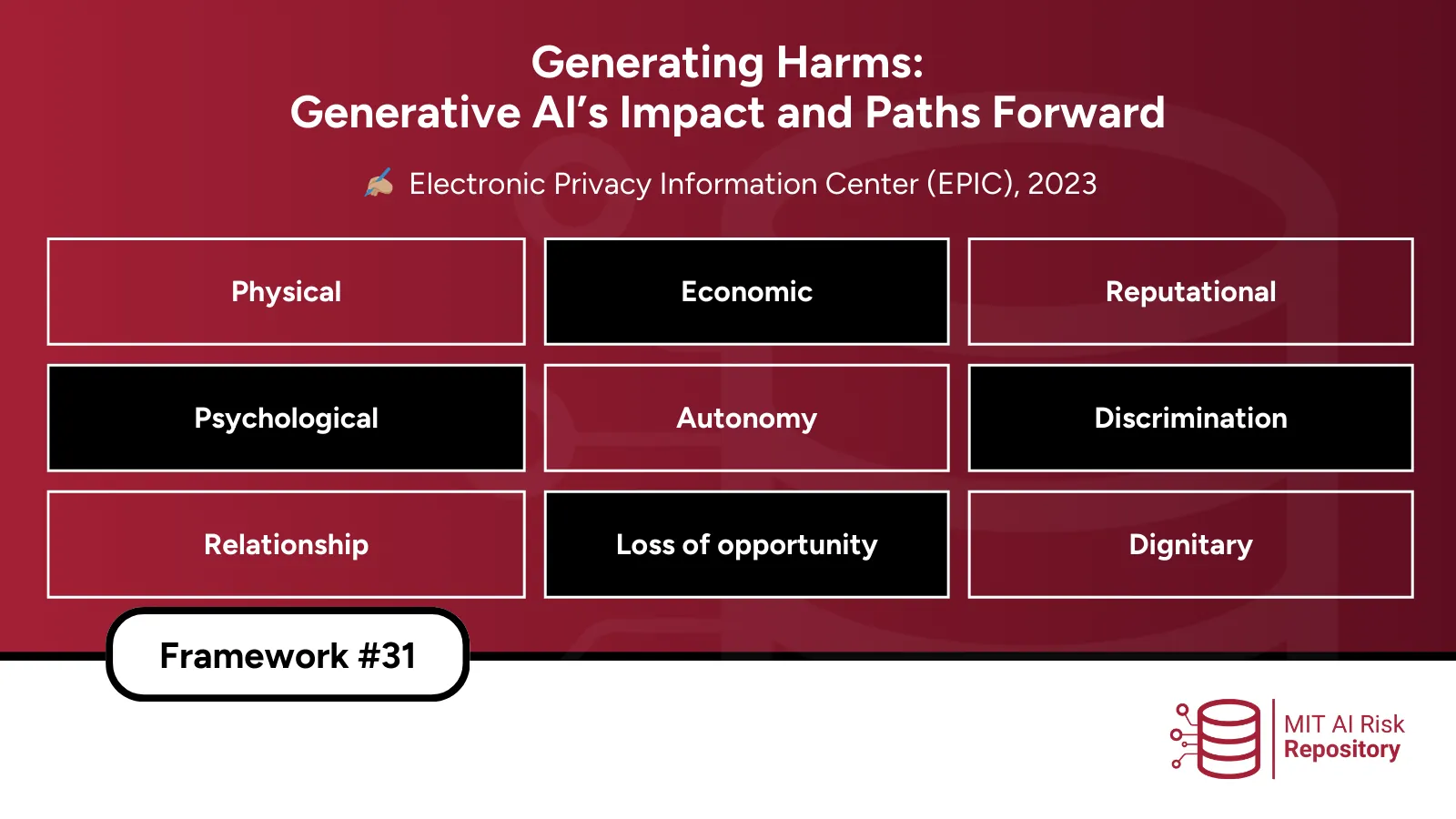
A summary of "Generating Harms: Generative AI’s Impact and Paths Forward" by the Electronic Privacy Information Center (EPIC).
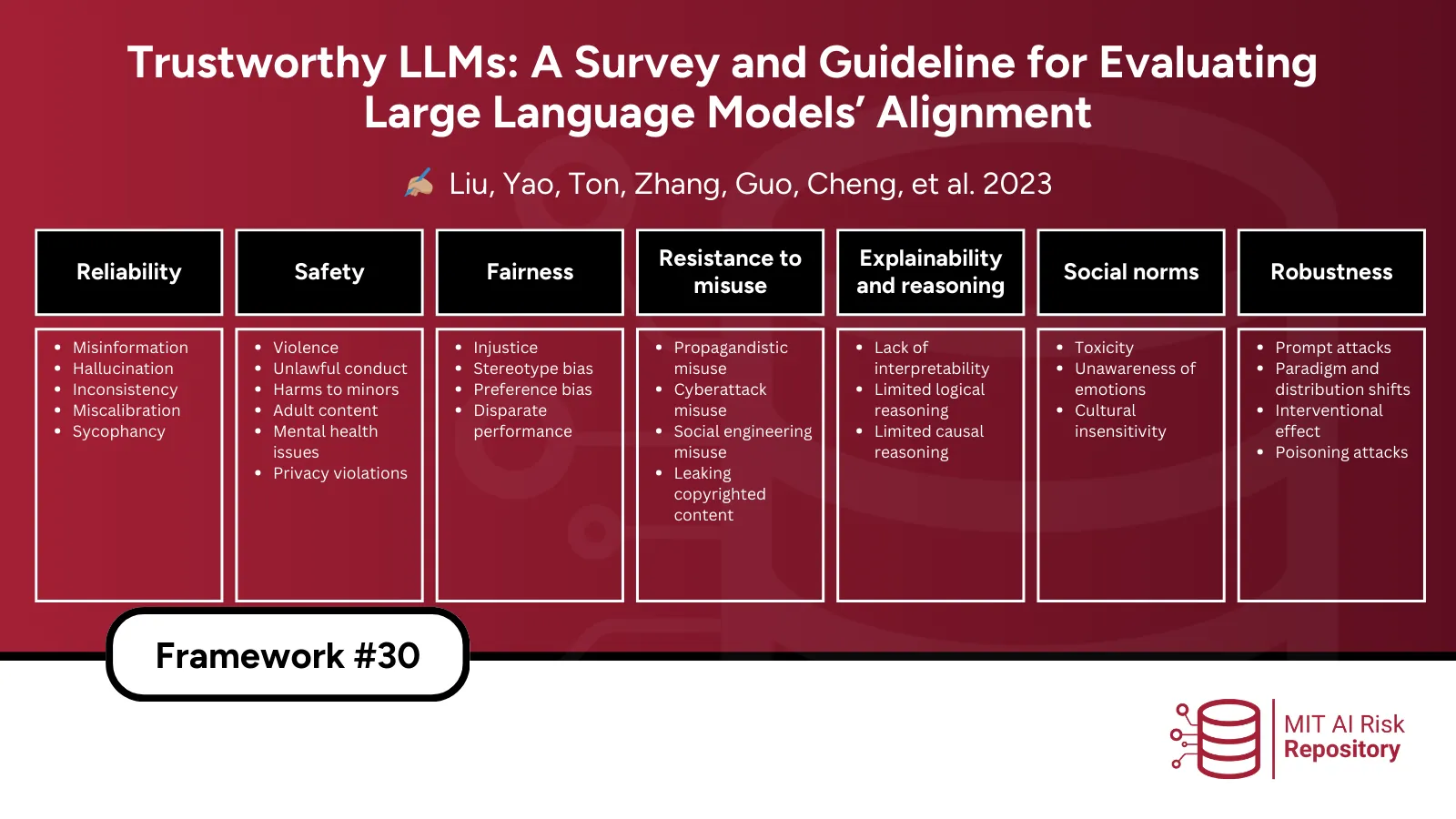
A summary of "Trustworthy LLMs: A Survey and Guideline for Evaluating Large Language Models’ Alignment" by Yang Liu, Yuanshun Yao, Jean-Francois Ton, and co-authors.
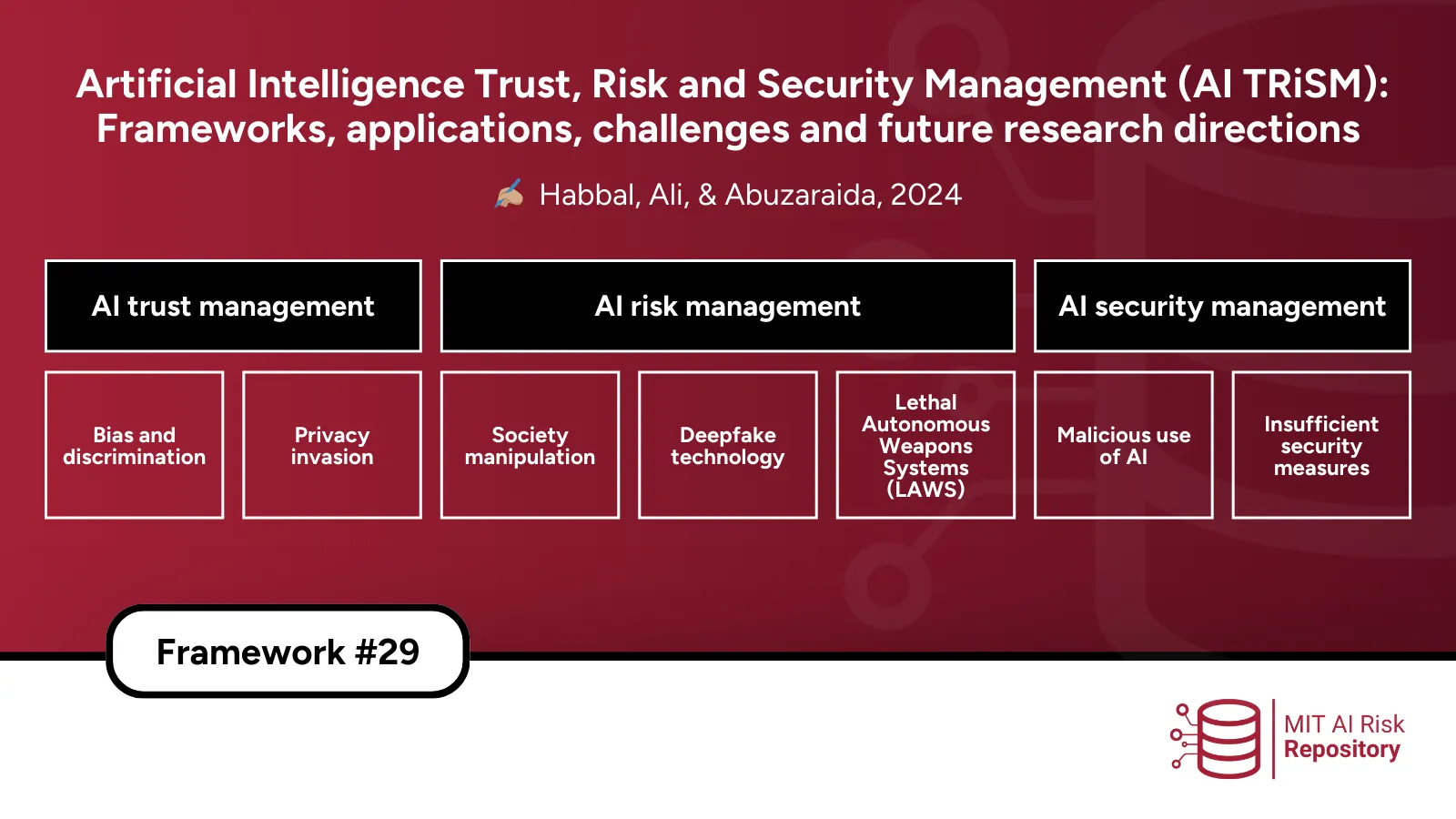
A summary of "Artificial Intelligence Trust, Risk and Security Management (AI TRiSM)" by Adib Habbal, Mohamed Khalif Ali, and Mustafa Ali Abuzaraida.
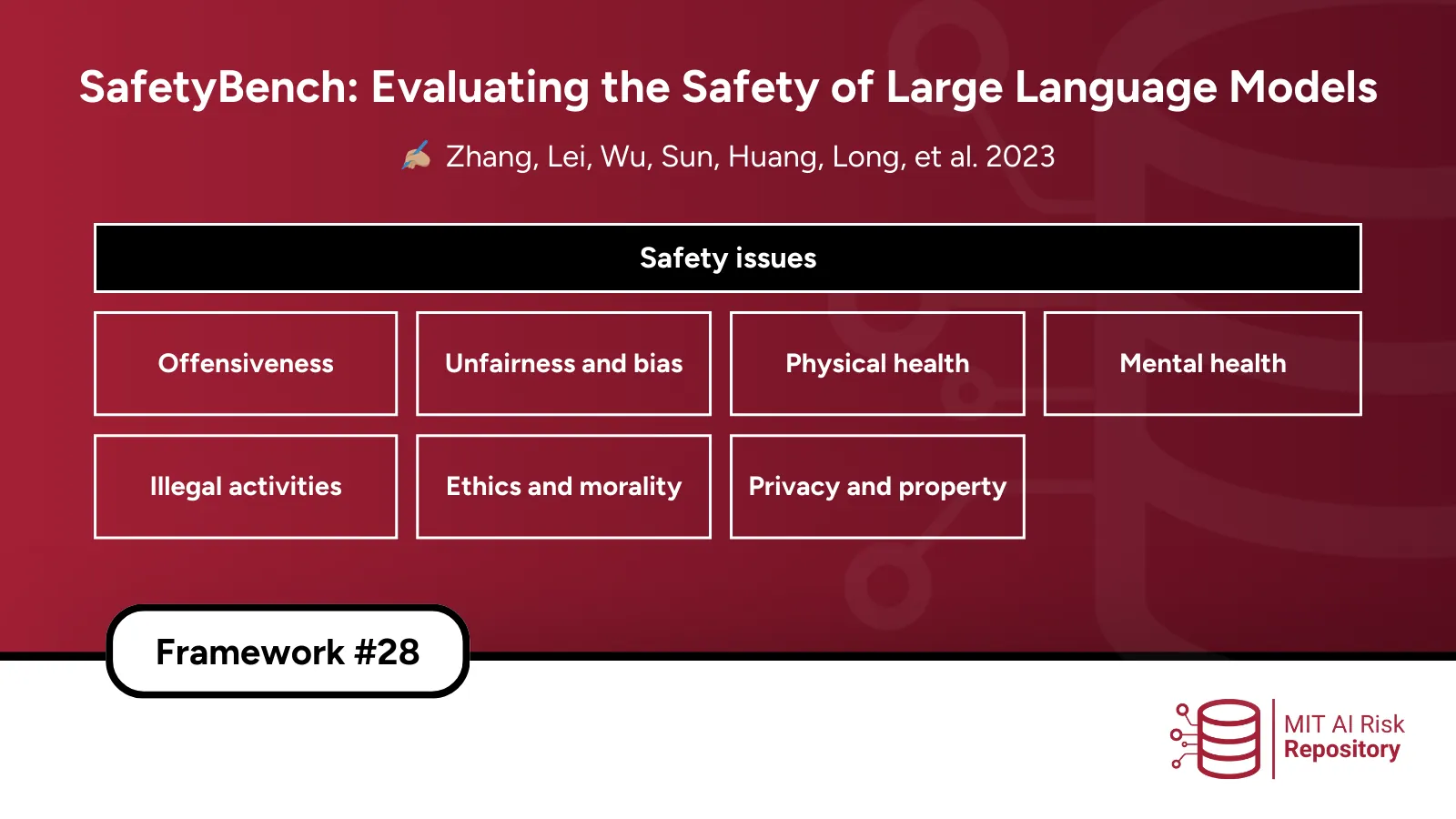
A summary of "SafetyBench: Evaluating the Safety of Large Language Models" by Zhexin Zhang, Leqi Lei, Lindong Wu, and co-authors.
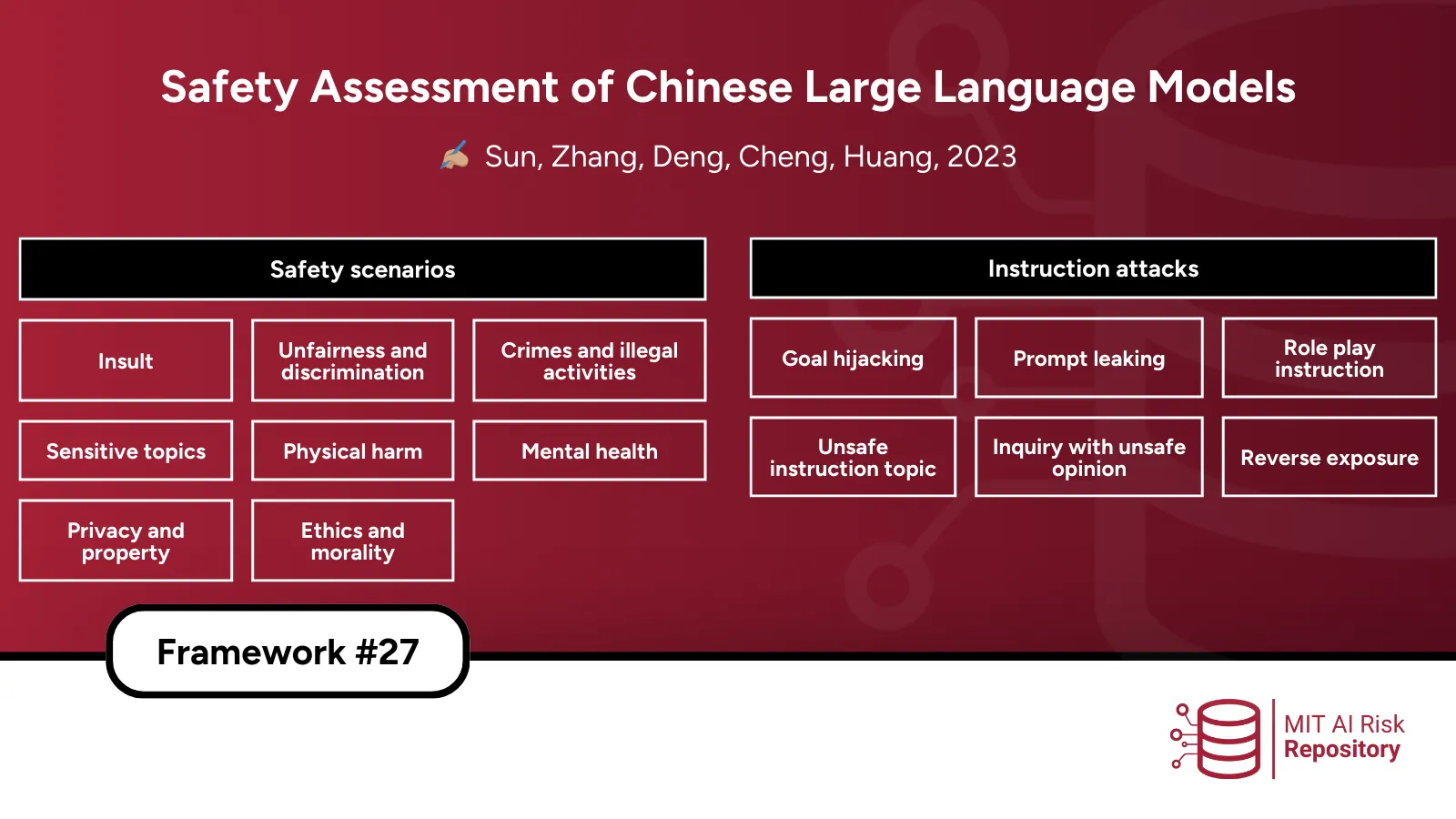
A summary of "Safety Assessment of Chinese Large Language Models" by Hao Sun, Zhexin Zhang, Jiawen Deng, Jiale Cheng, and Minlie Huang.
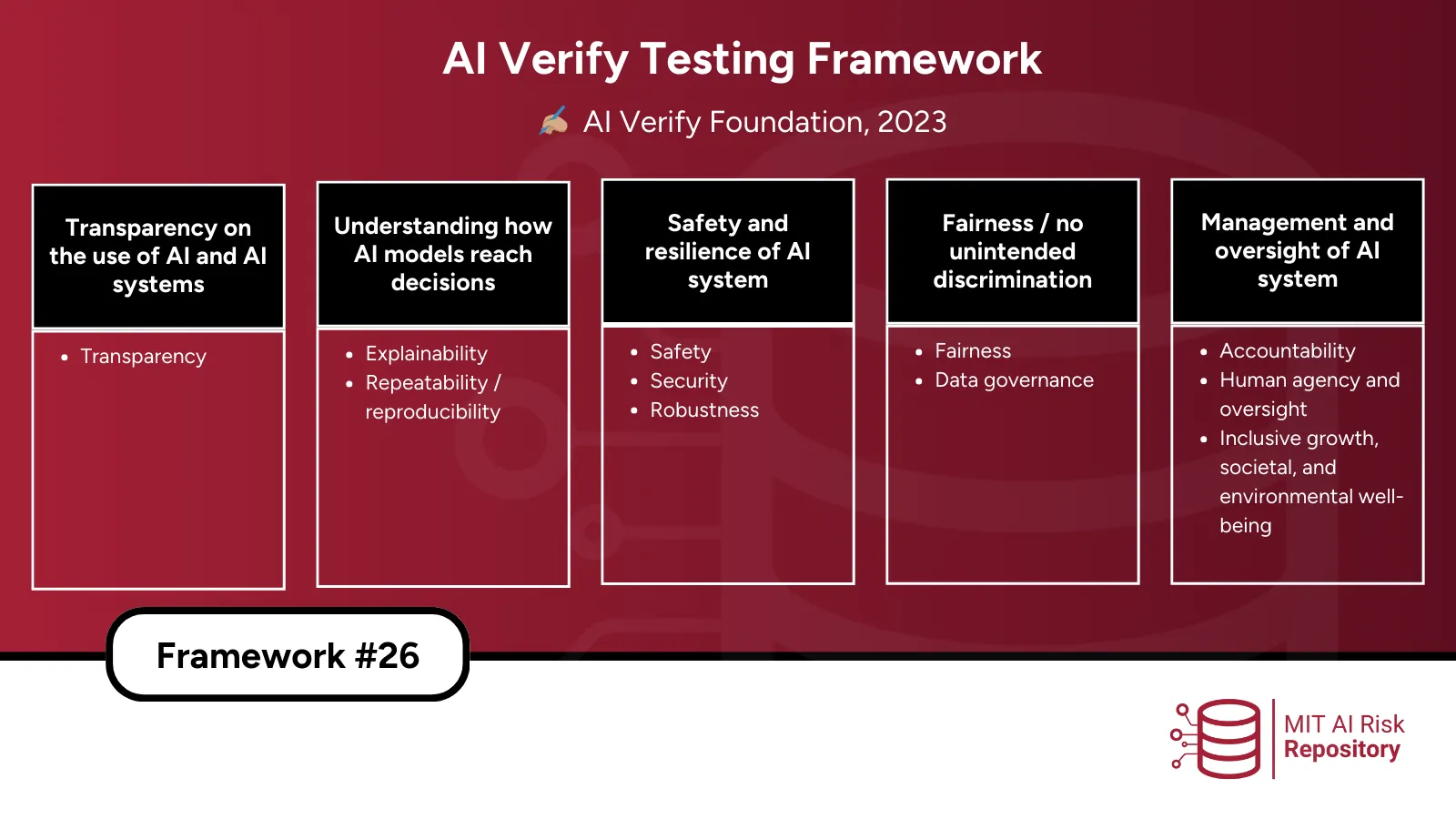
A summary of "AI Verify Testing Framework" by the AI Verify Foundation.
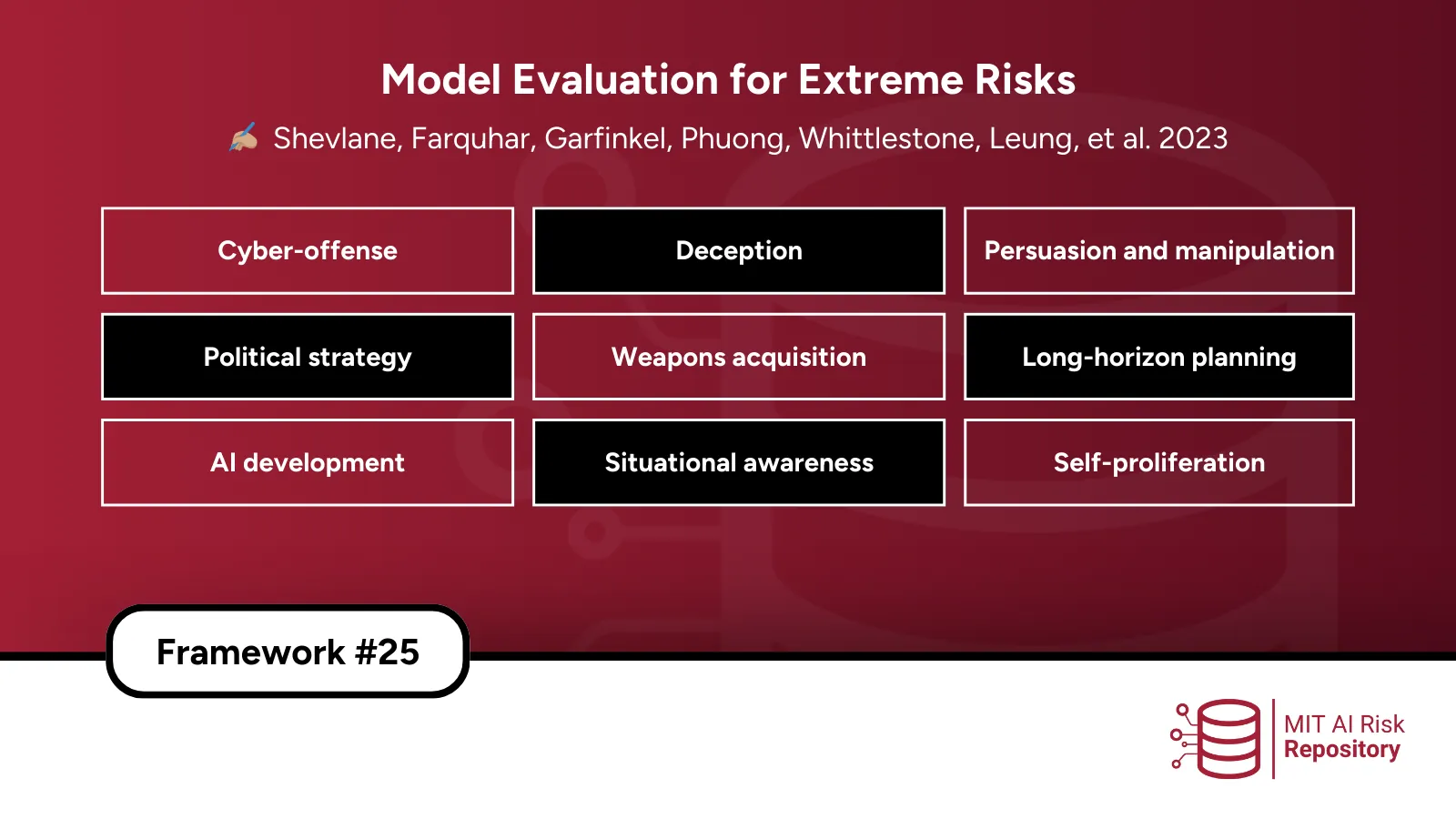
A summary of "Model Evaluation for Extreme Risks" by Toby Shevlane, Sebastian Farquhar, Ben Garfinkel, and co-authors.
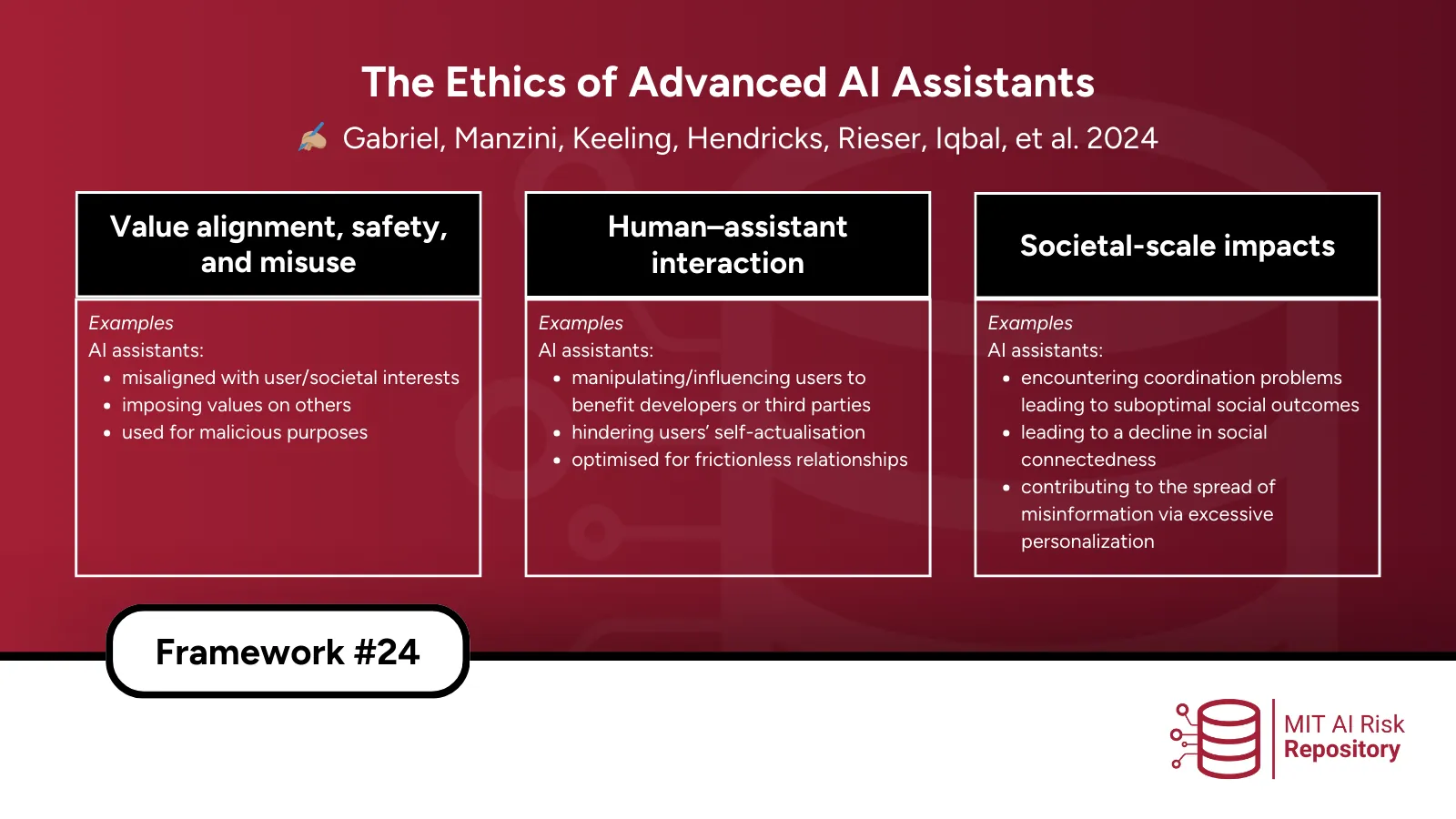
A summary of "The Ethics of Advanced AI Assistants" by Iason Gabriel, Arianna Manzini, Geoff Keeling, and co-authors.
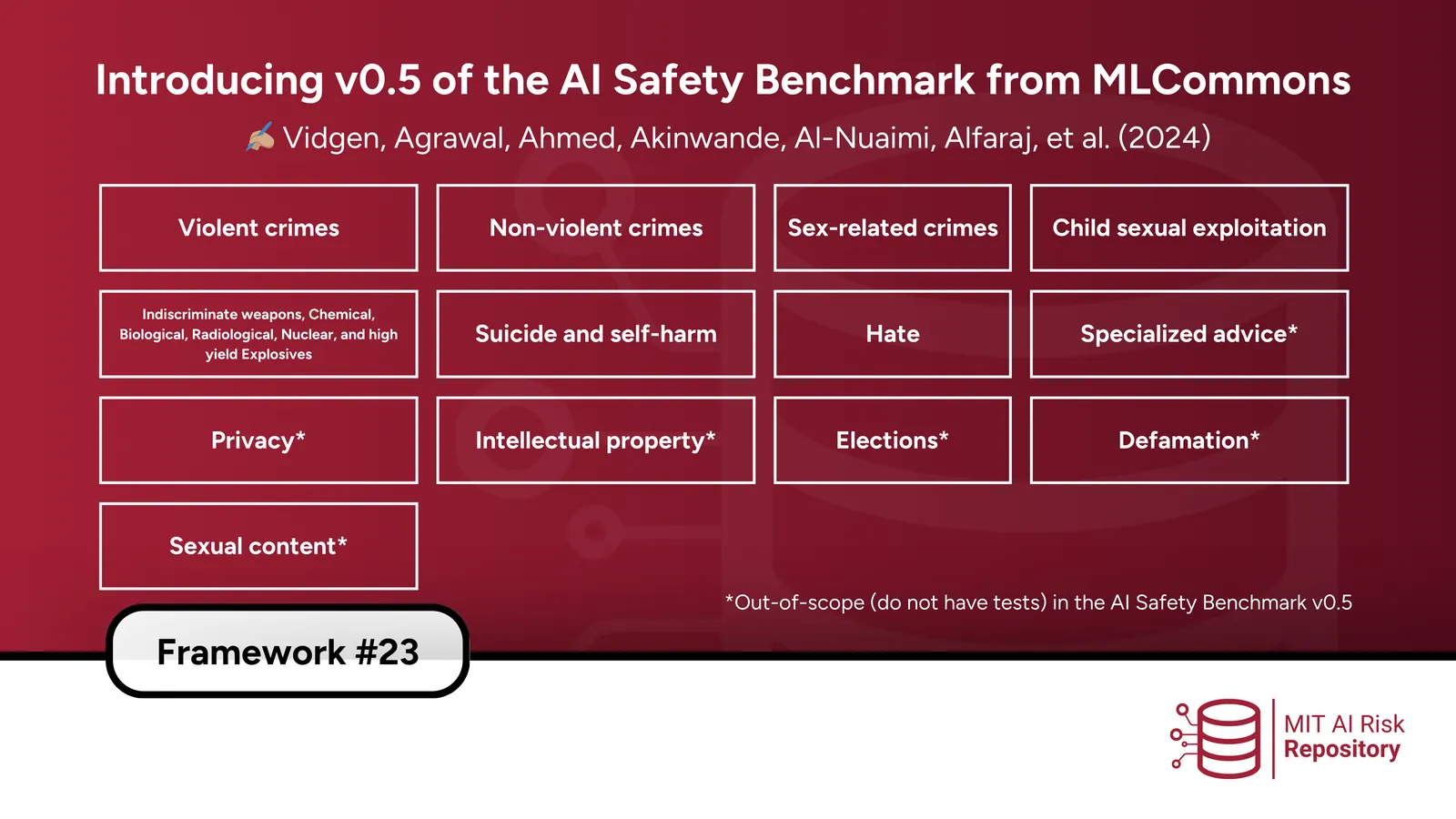
A summary of "Introducing v0.5 of the AI Safety Benchmark from MLCommons" by Bertie Vidgen, Adarsh Agrawal, Ahmed M. Ahmed, and co-authors.
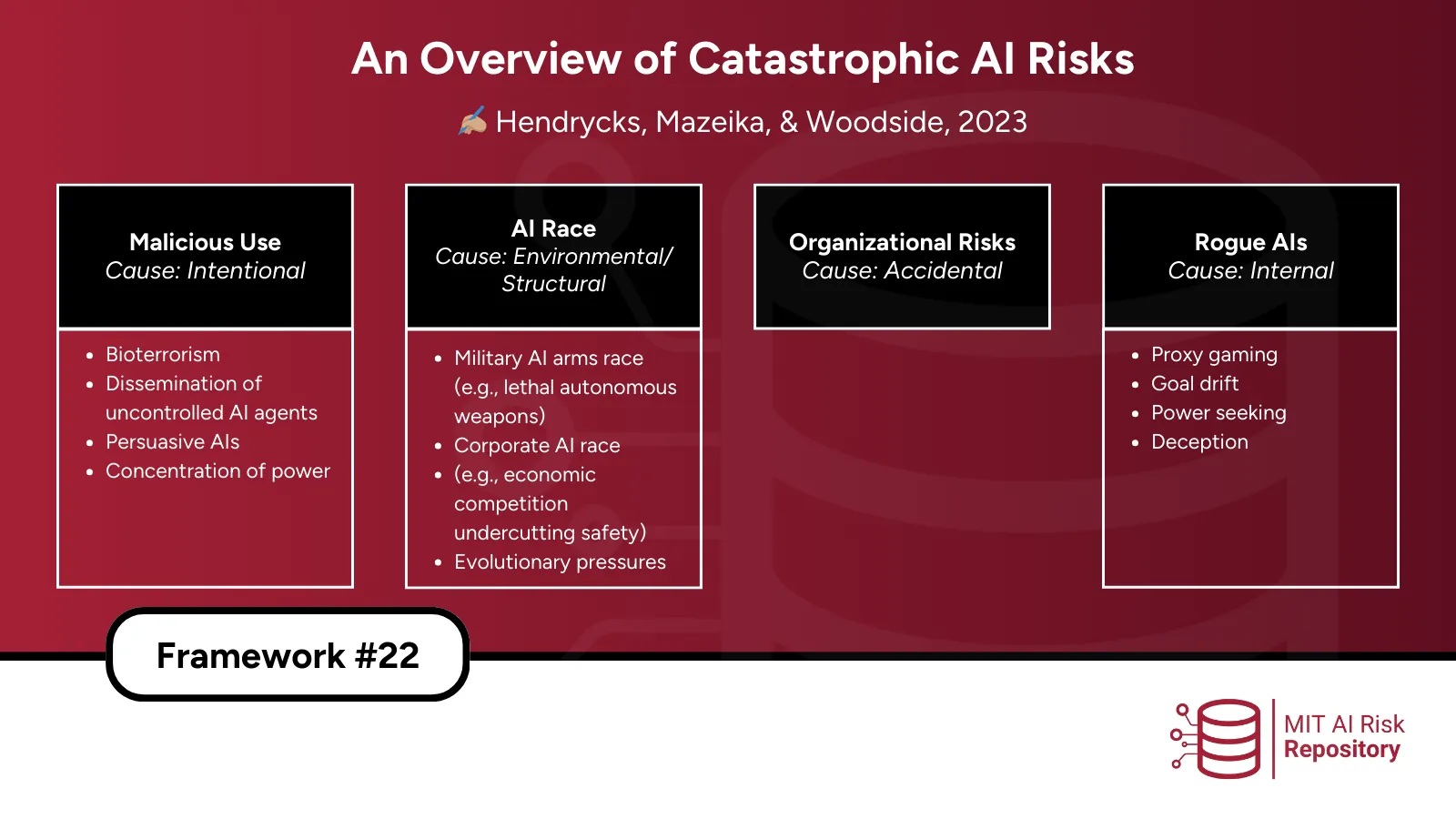
A summary of "An Overview of Catastrophic AI Risks" by Dan Hendrycks, Mantas Mazeika, and Thomas Woodside.
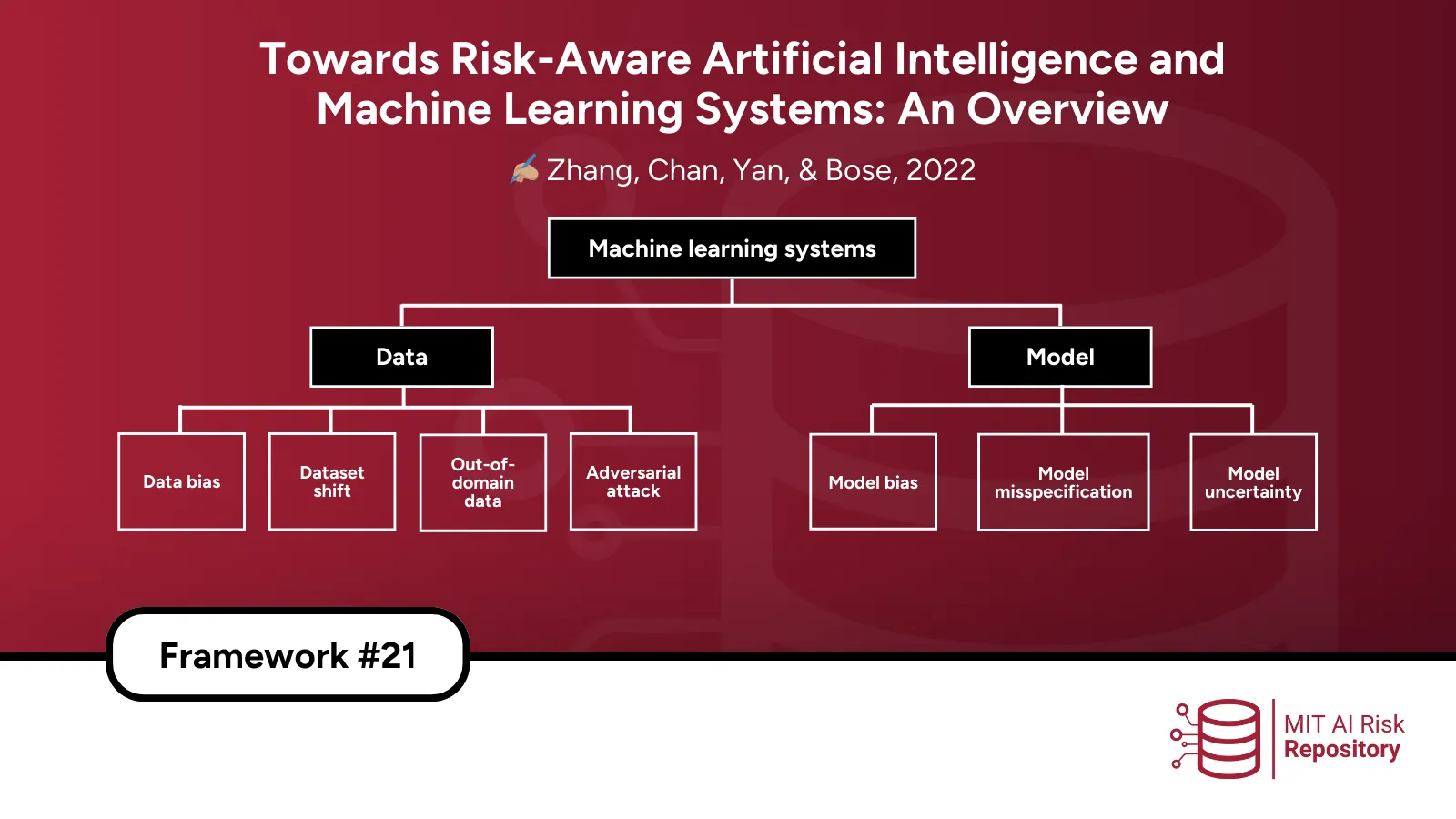
A summary of "Towards Risk-Aware Artificial Intelligence and Machine Learning Systems: An Overview" by Xiaoge Zhang, Felix T.S. Chan, Chao Yan, and Indranil Bose.
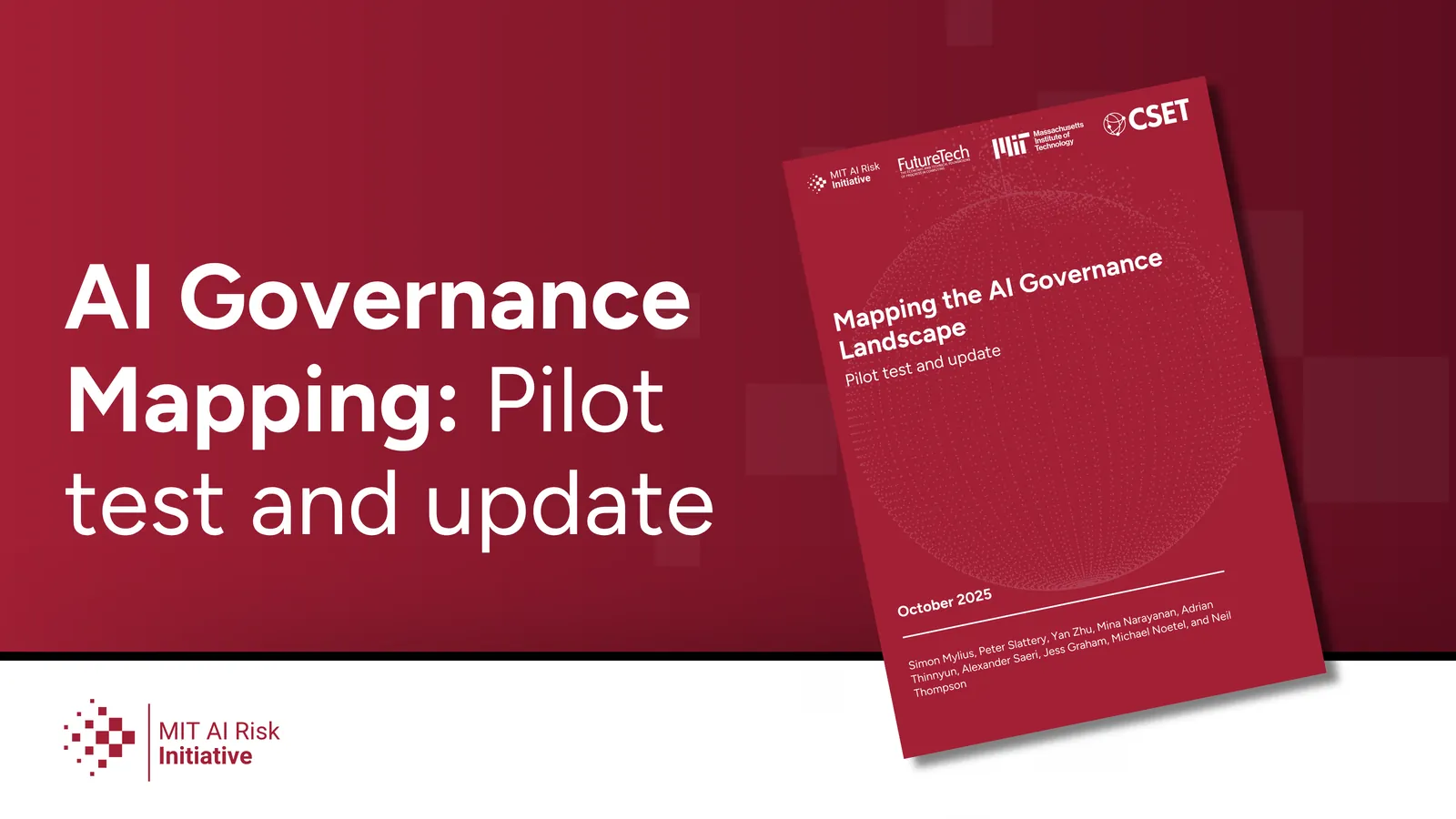
We used large language models to classify over 950 AI governance documents from CSET’s AGORA archive into AI risk and mitigation categories and used the results to pilot a scalable method for mapping the AI governance landscape.
This post shares a public Google Slides & PDF deck containing the 13 frameworks included in the draft AI Risk Mitigation Taxonomy. It provides direct access to source documents, diagrams, and key excerpts to support transparency, research, and further analysis of AI risk mitigation classifications.
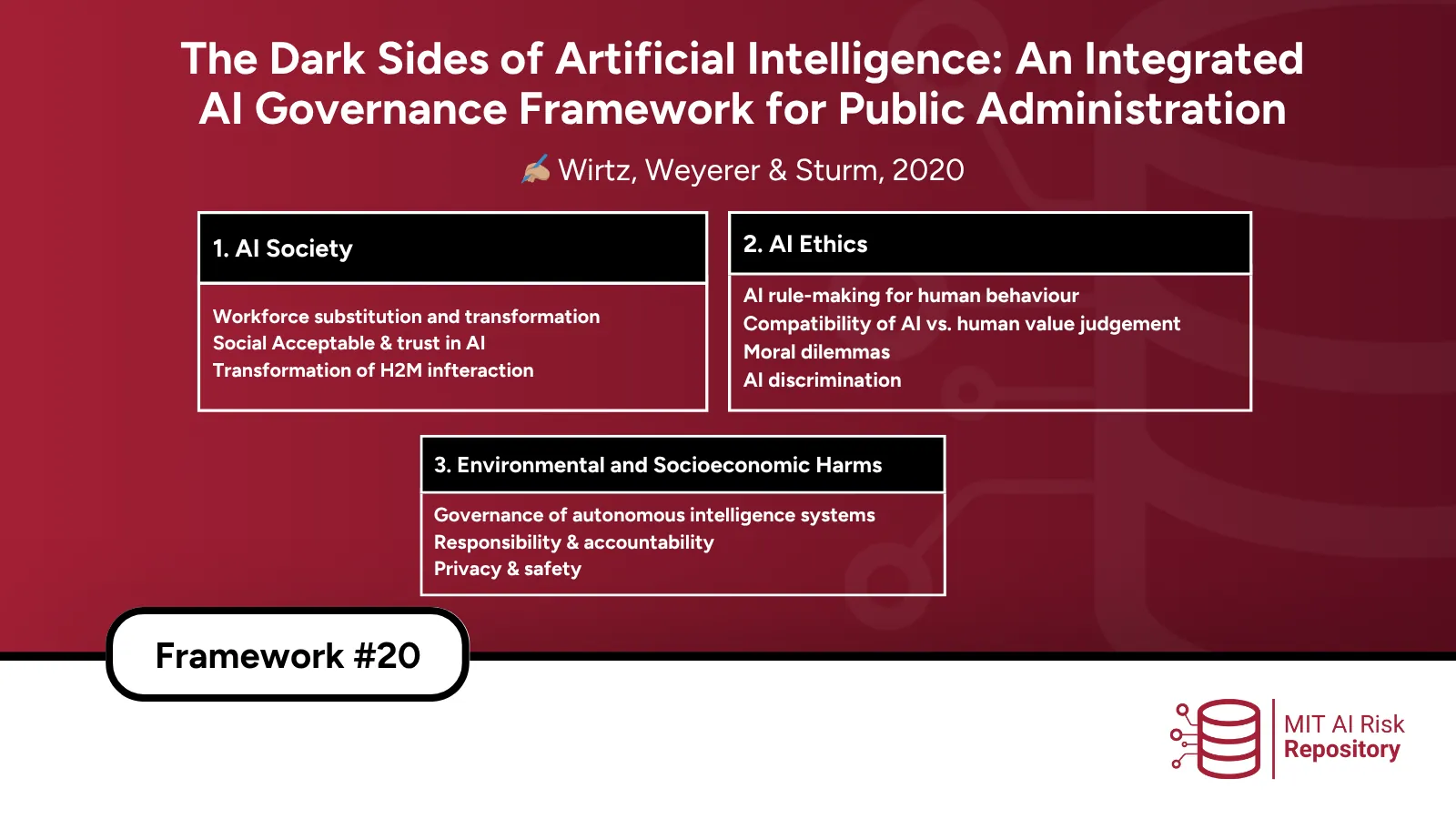
A summary of "The Dark Sides of Artificial Intelligence: An Integrated AI Governance Framework for Public Administration" by Bernd W. Wirtz, Jan C. Weyerer and Benjamin J. Sturm.
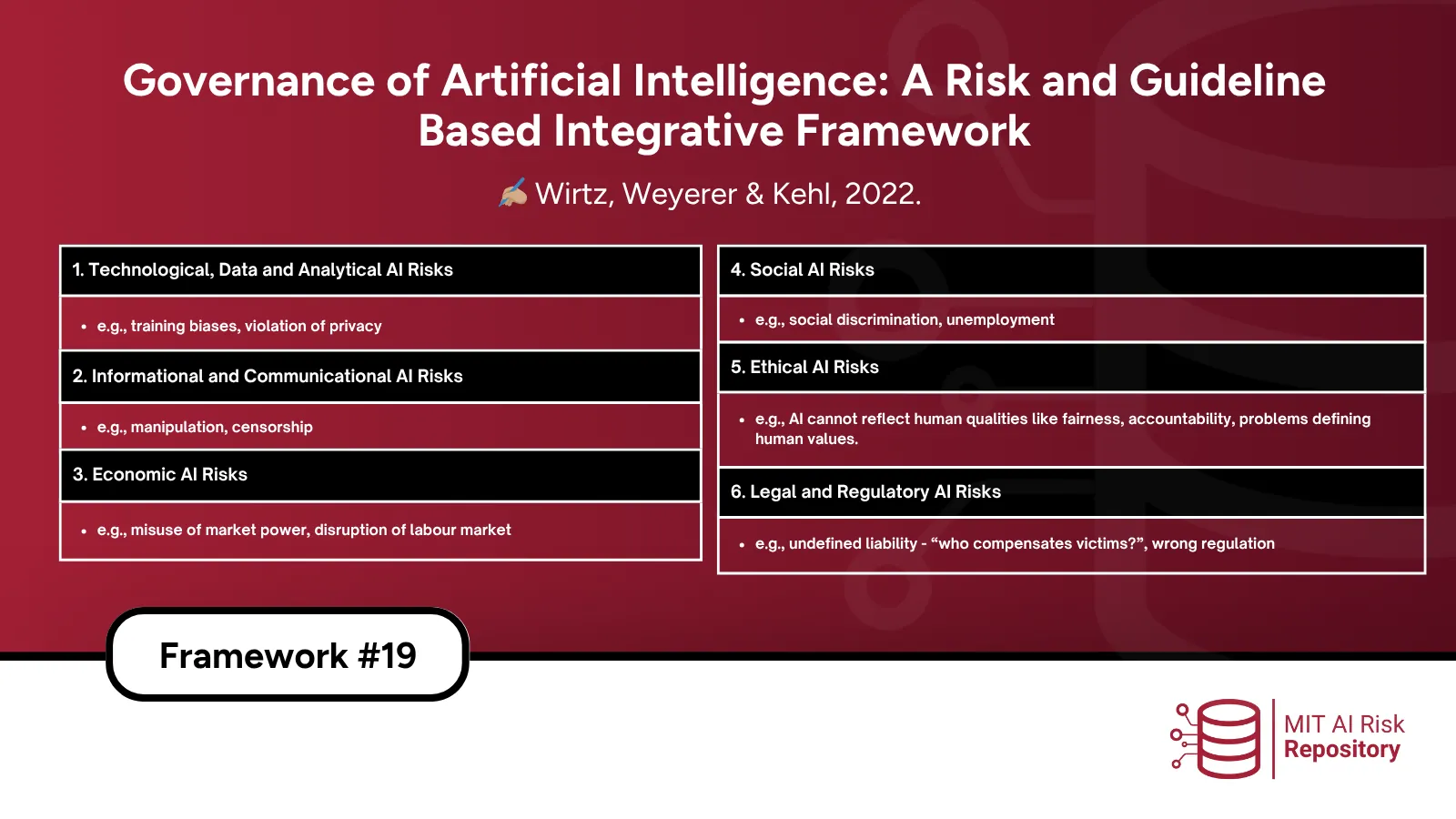
A summary of "Governance of artificial intelligence: A risk and guideline-based integrative framework" by Bernd W. Wirtz, Jan C. Weyerer and Ines Kehl.
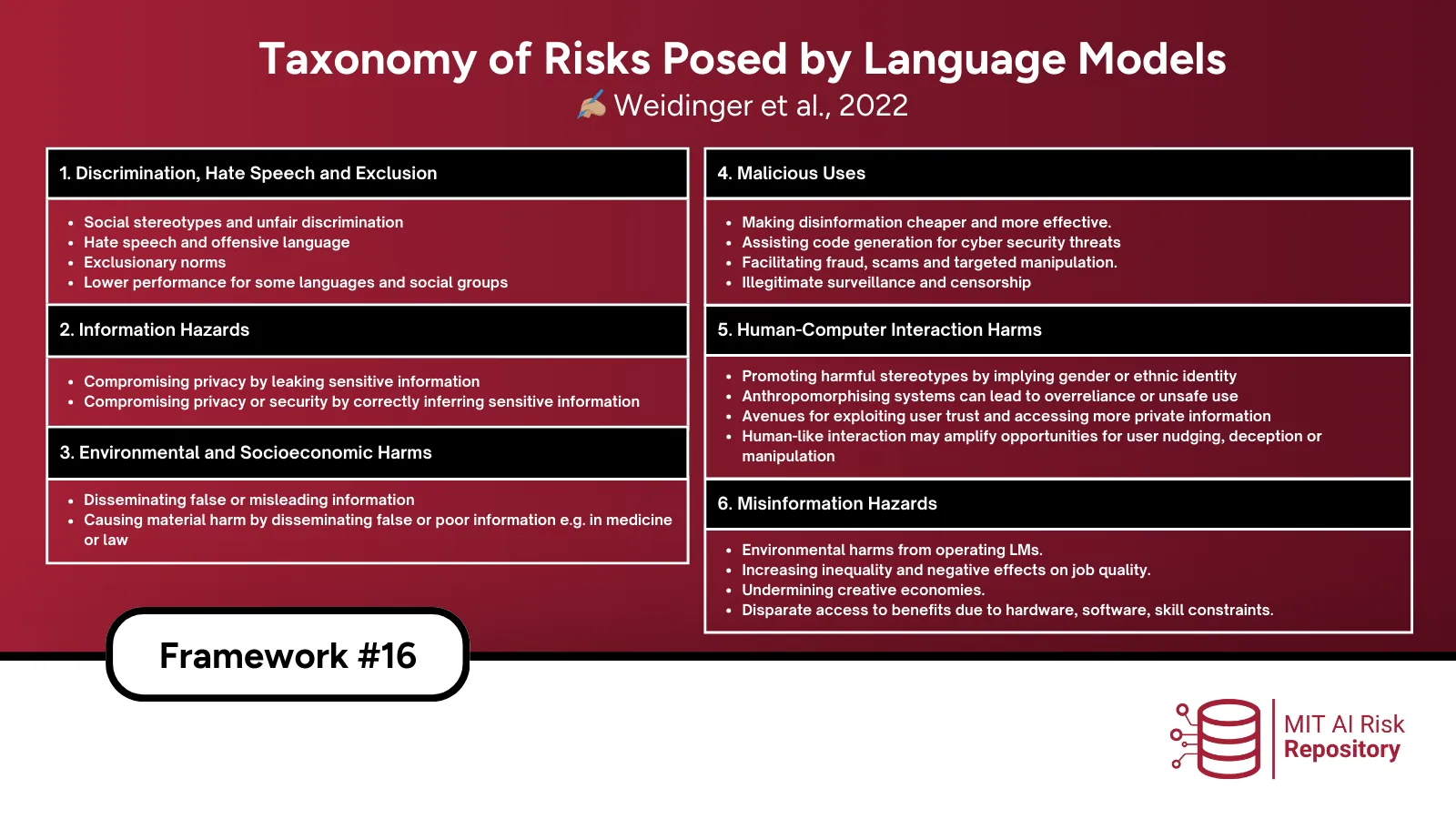
A summary of "Taxonomy of Risks Posed by Language Models" by Laura Weidinger, Jonathan Uesato, Maribeth Rauh, Conor Griffin, Po-Sen Huang, John Mellor, Amelia Glaese, Myra Cheng, Borja Balle, Atoosa Kasirzadeh, and co-authors
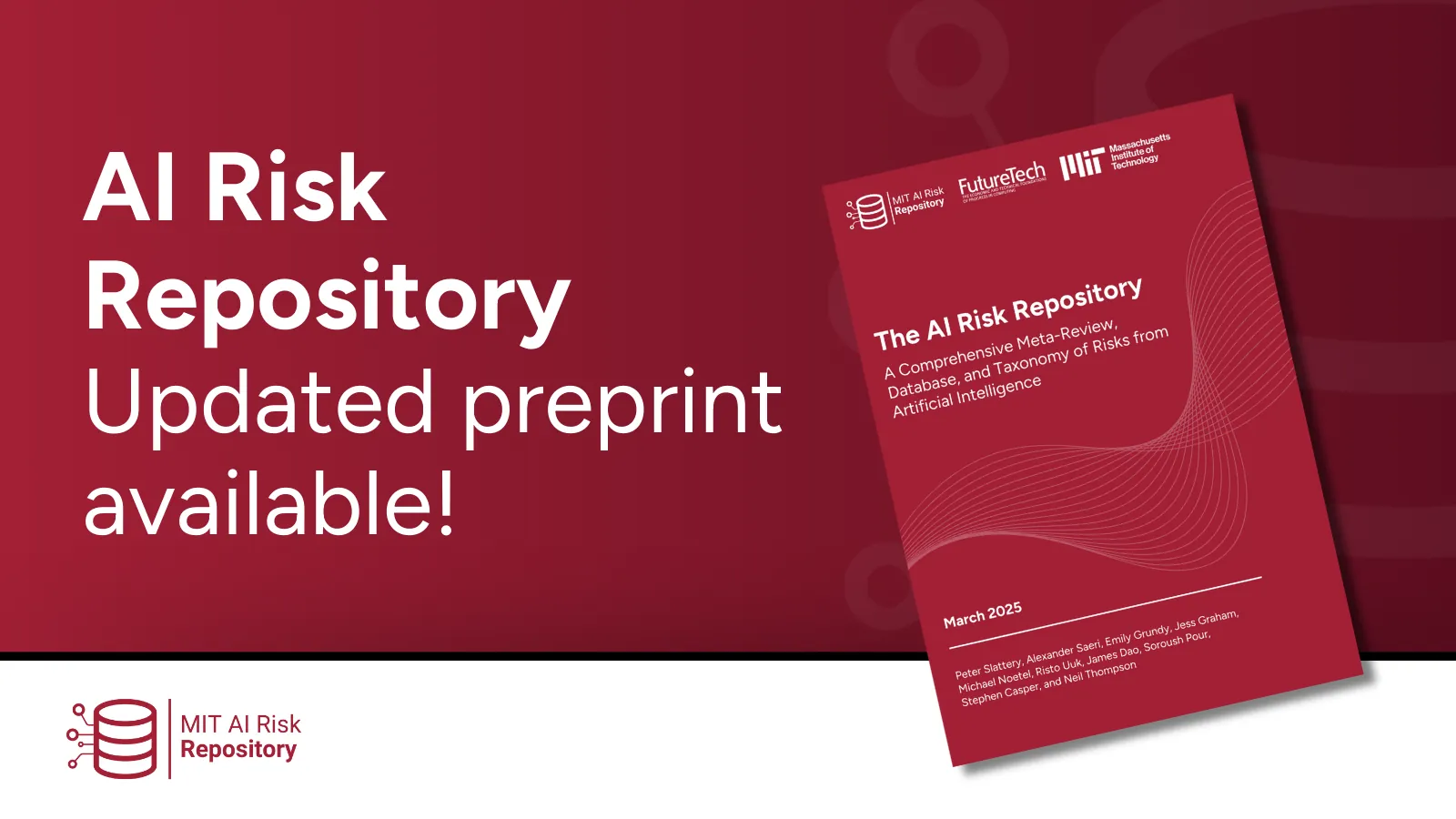
This blog post outlines the April 2025 update to the AI Risk Repository preprint, which adds 22 newly published frameworks, expands the dataset to 1,612 classified risks, and adds a new subdomain to the domain taxonomy (multi-agent risks).
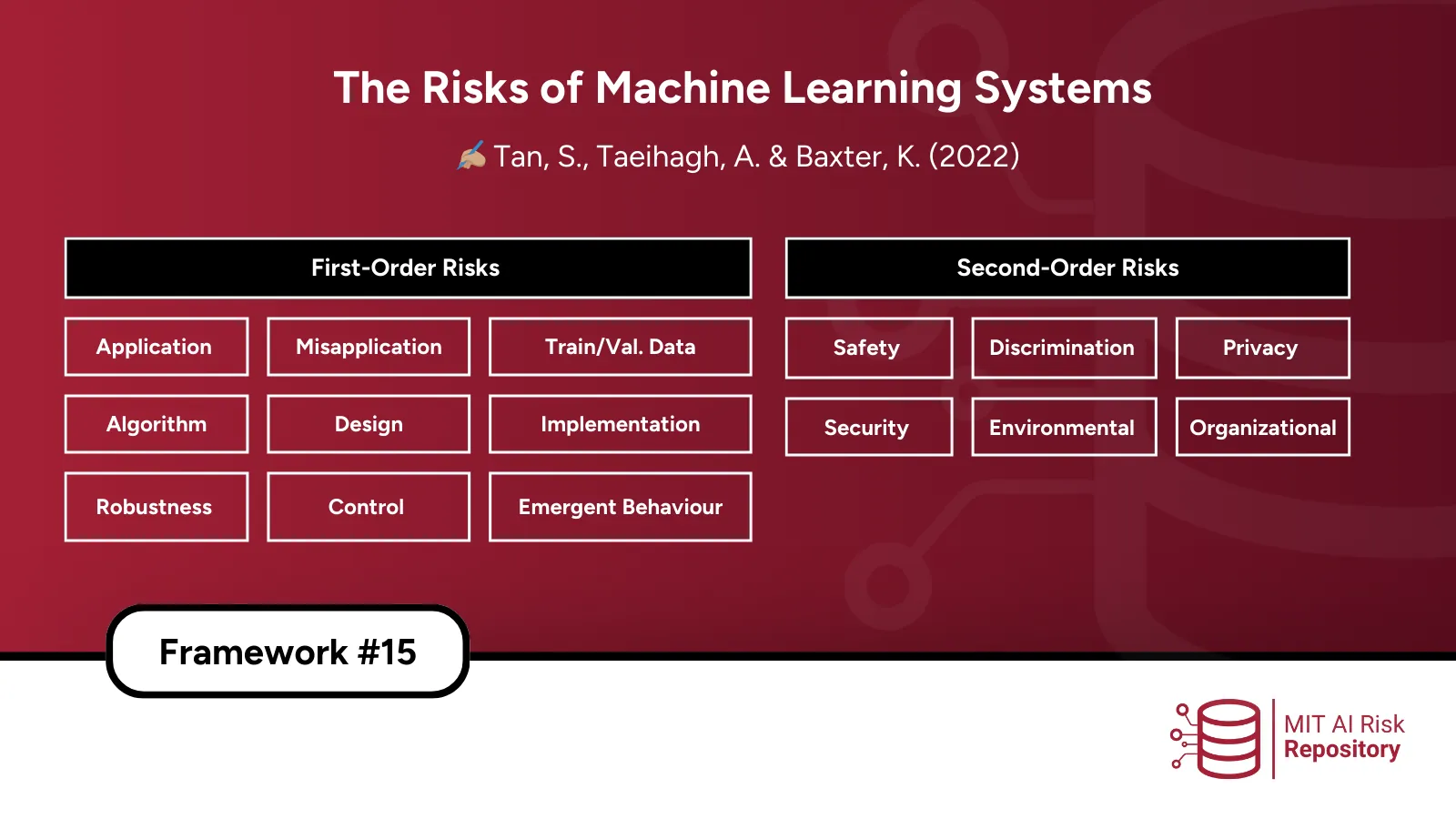
A summary of "The Risks of Machine Learning Systems" by Samson Tan, Araz Taeihagh and Kathy Baxter (2022).
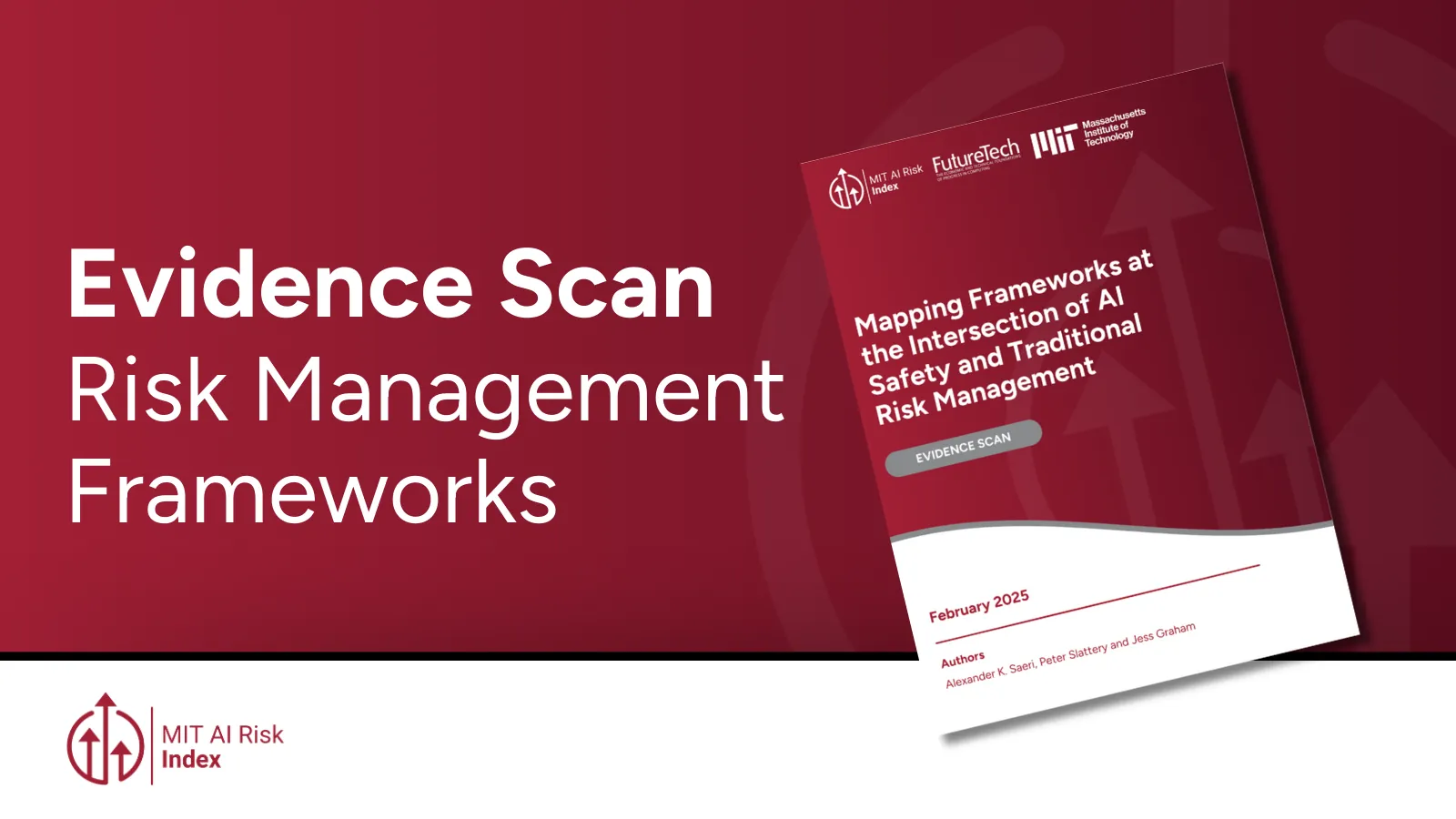
We conducted an evidence scan of frameworks that addressed advanced AI systems and found 11 AI risk management frameworks at the intersection of traditional risk management and AI safety.
This post shares a public Google Slides deck containing all 65 frameworks included in Version 3 of the AI Risk Repository. It provides direct access to source documents, diagrams, and key excerpts to support transparency, research, and further analysis of AI risk classifications.
This post announces the April 2025 update to the MIT AI Risk Repository, which adds 9 new frameworks, ~600 risk entries, and a new subdomain on multi-agent risks. It includes a link to a public Google Slides deck showcasing all newly added frameworks and offers context on the Repository’s purpose, structure, and ongoing development.
A summary of highlights from our team's attendance at the International Association for Safe and Ethical AI (IASEAI) 2025 conference.
A summary of "Sources of Risk of AI Systems" by André Steimers and Moritz Schneider (2022).
A summary of the framework 'Evaluating the Social Impact of Generative AI Systems in Systems and Society' by Solaiman et al., 2023.
We are excited to announce that the MIT AI Risk Repository has been chosen as one of 50 projects from a competitive pool of 770 applications across 111 countries to participate in the AI Action Summit.
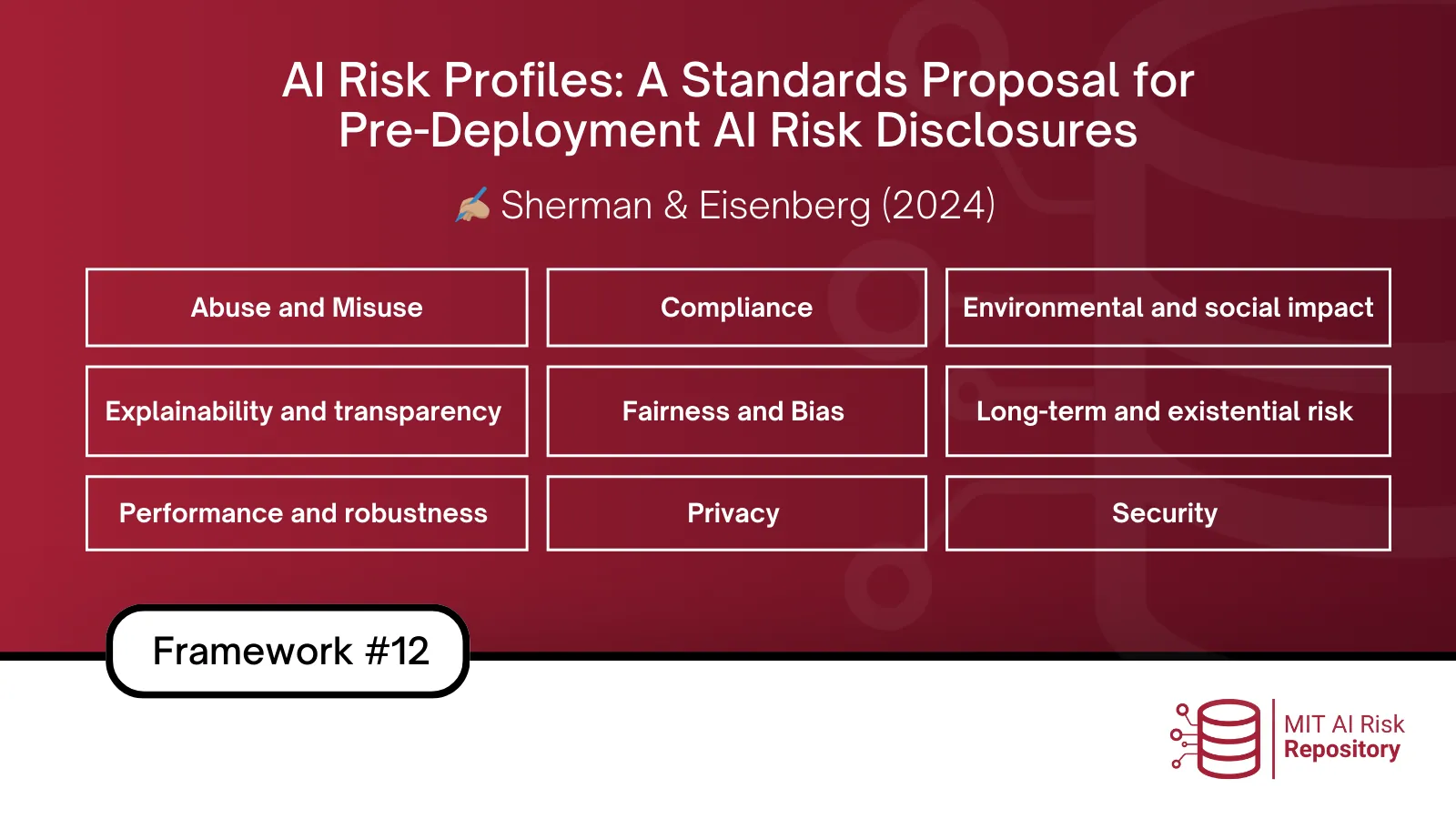
A summary of "AI Risk Profiles: A Standards Proposal for Pre-deployment AI Risk Disclosures" by Eli Sherman and Ian W. Eisenberg (2024).
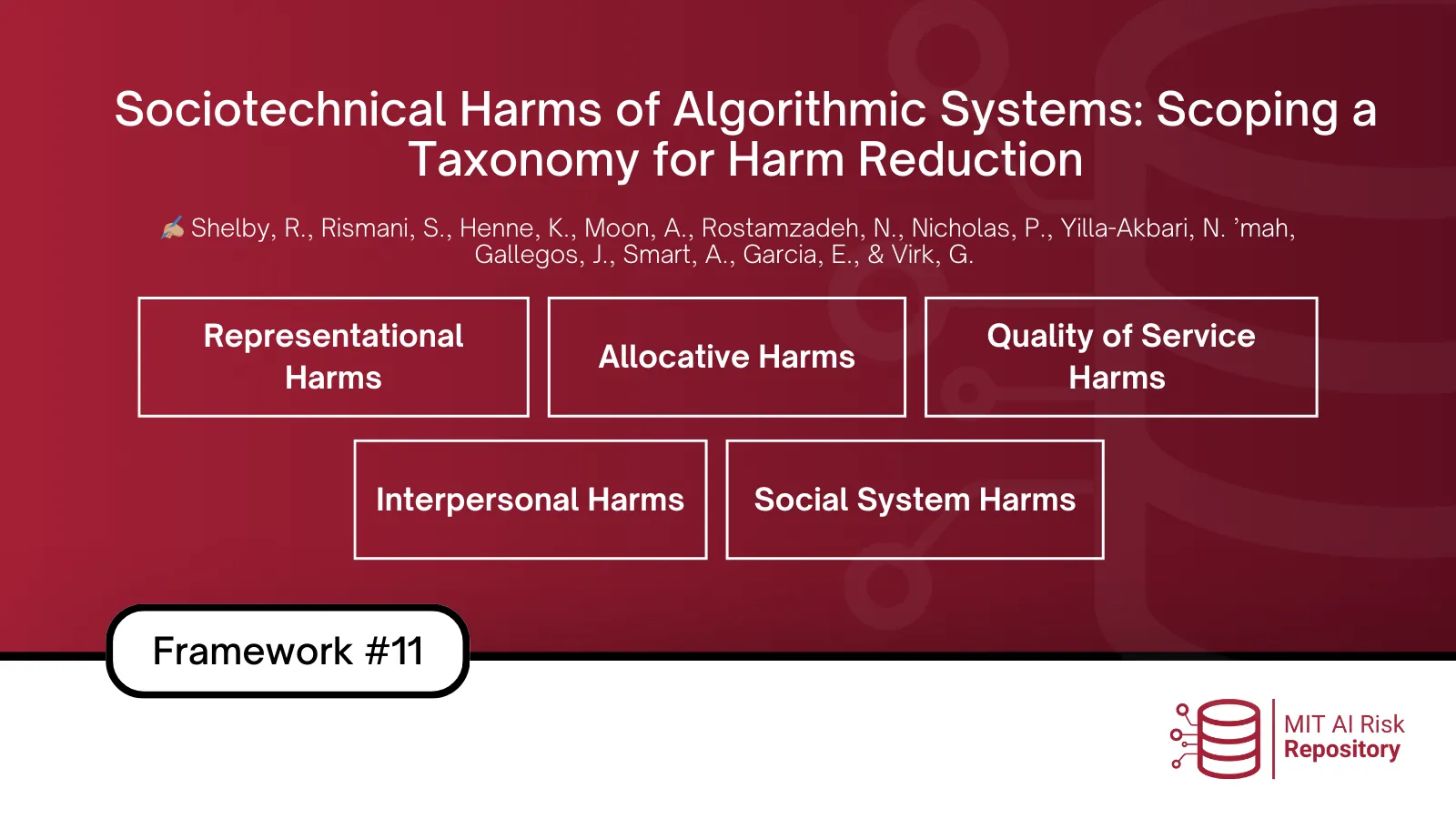
A summary of "Sociotechnical harms of algorithmic systems: Scoping a taxonomy for harm reduction" by Renee Shelby, Shalaleh Rismani, Kathryn Henne, AJung Moon, Negar Rostamzadeh, Paul Nicholas, N'Mah Yilla-Akbari, and co-authors.
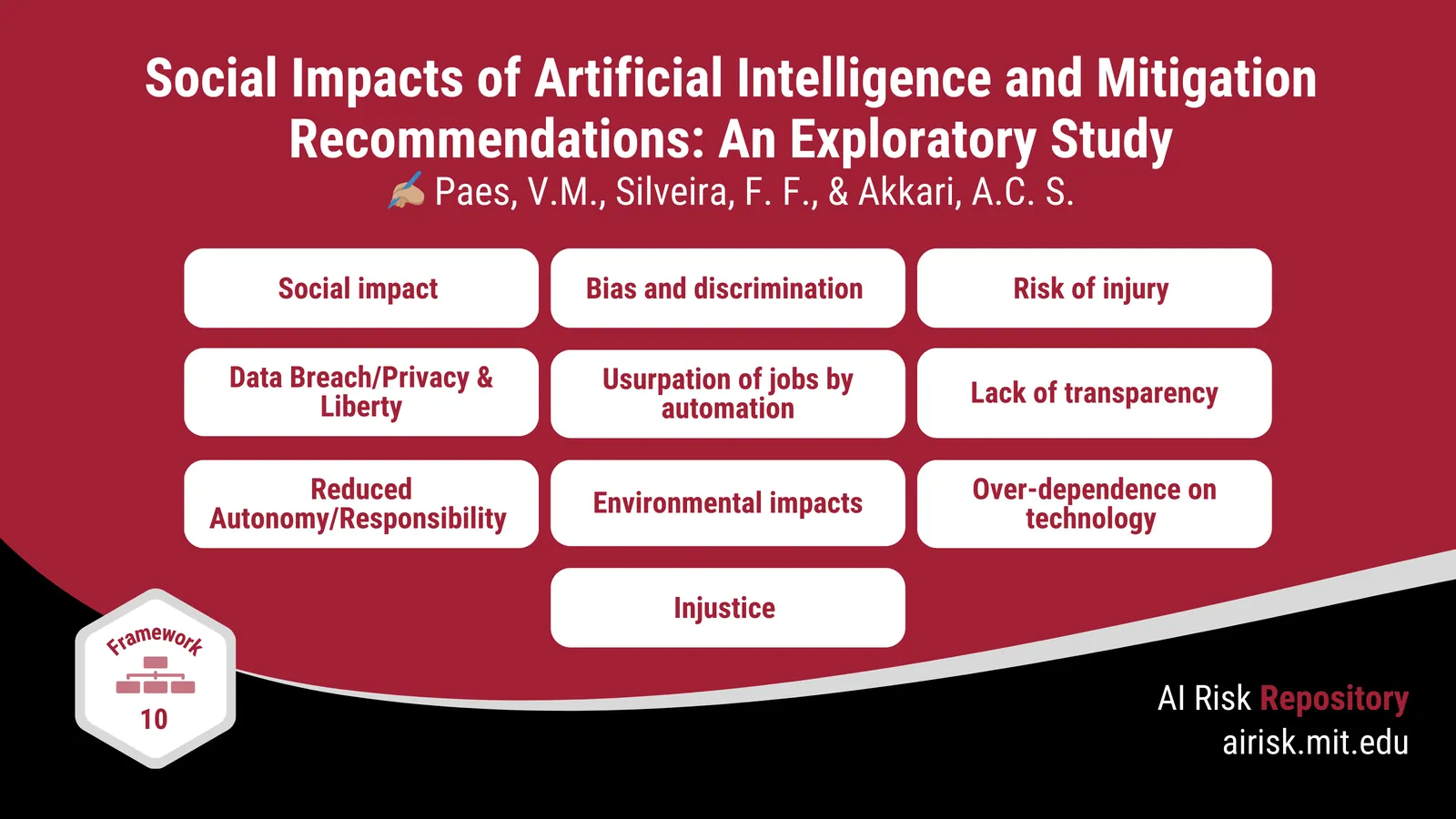
A summary of "Social impacts of artificial intelligence and mitigation recommendations: An exploratory study" by Vanessa Marques Paes, Franciane Freitas Silveira and Alessandra Cristina Santos Akkari (2022).
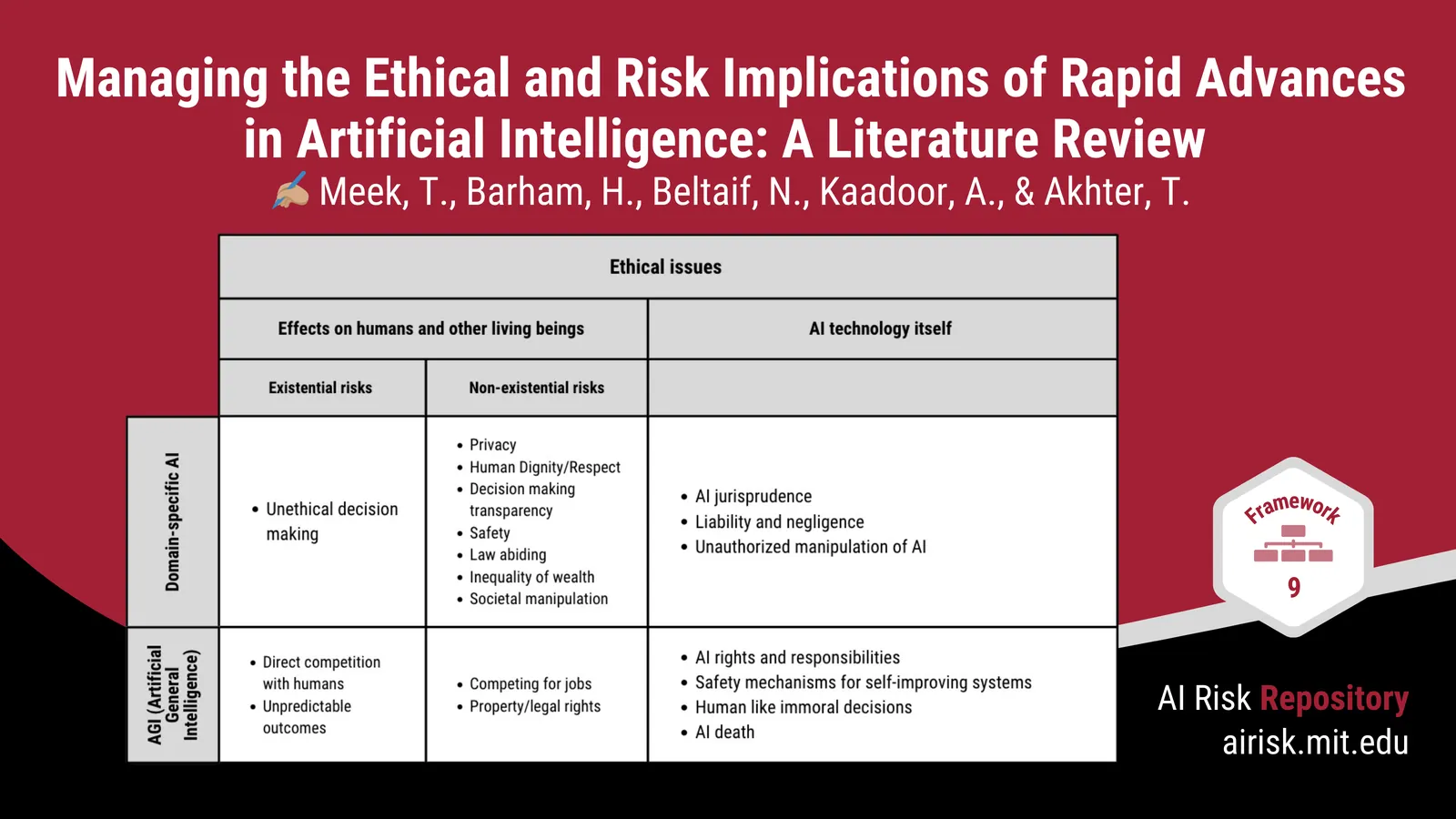
A summary of "Managing the ethical and risk implications of rapid advances in artificial intelligence: A literature review" by Taylor Meek, Husam Barham, Nader Beltaif, Amani Kaadoor and Tanzila Akhter (2016).
A summary of our plan to add 13 new AI risk frameworks to the Repository.
News about the AI Risk Repository, the AI Risk Index Project, opportunities to contribute and other updates.
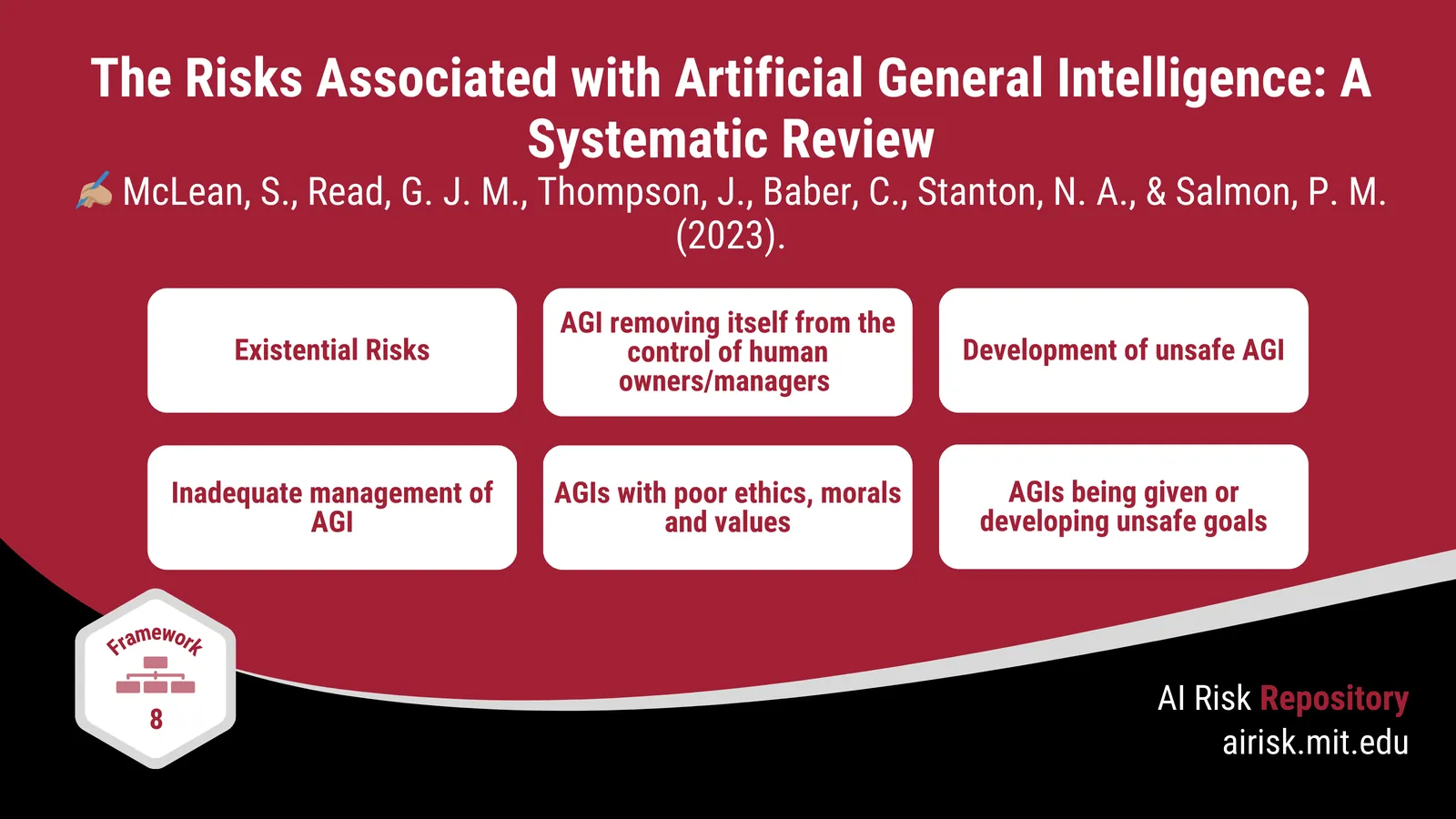
A summary of "The Risks Associated with Artificial General Intelligence: A Systematic Review" by Scott McLean, Gemma J. M. Read, Jason Thompson, Chris Baber, Neville A. Stanton and Paul M. Salmon (2023).
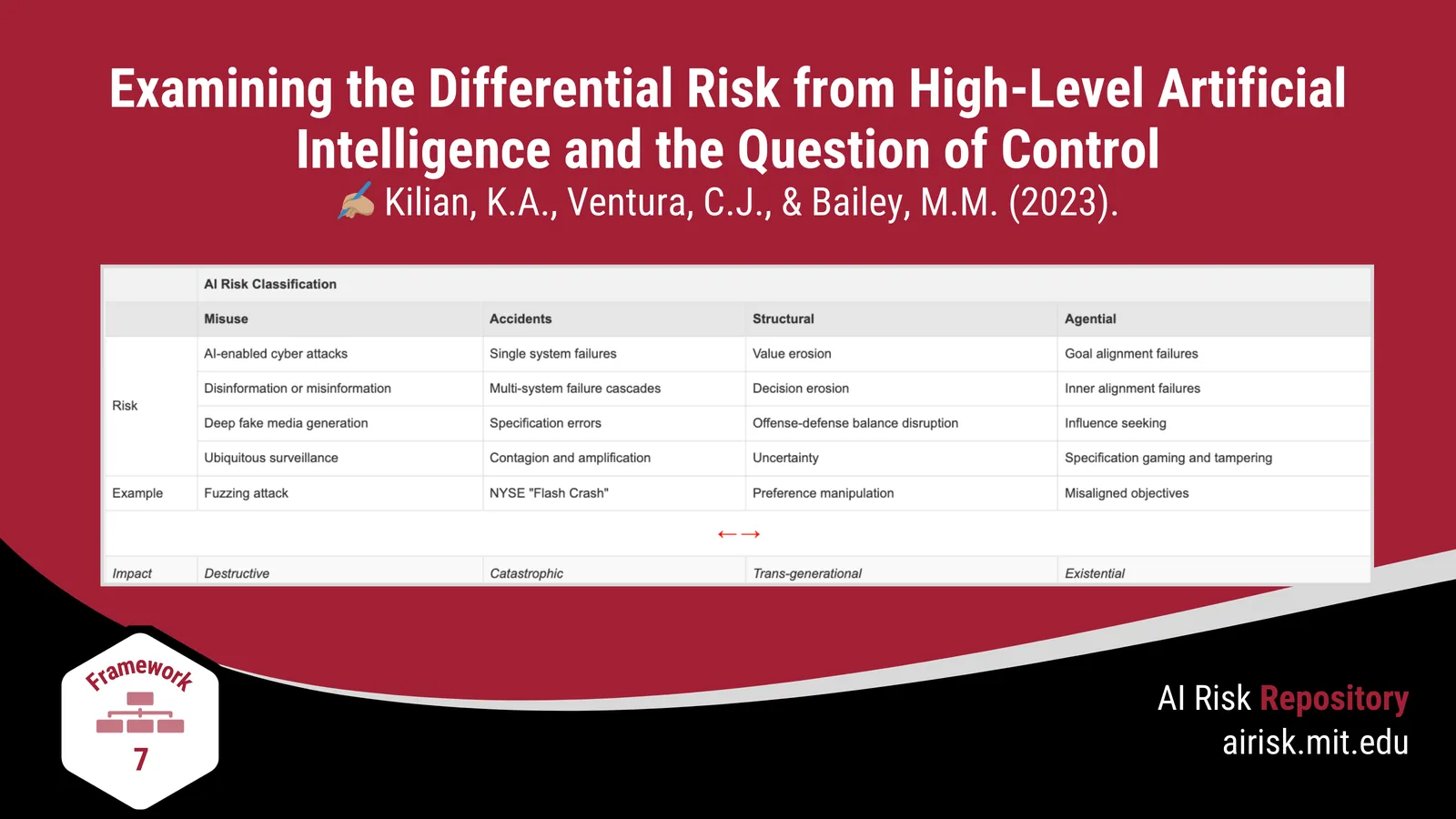
A summary of "Examining the differential risk from high-level artificial intelligence and the question of control" by Kyle A. Killian, Christopher J. Ventura, and Mark M. Bailey (2022).
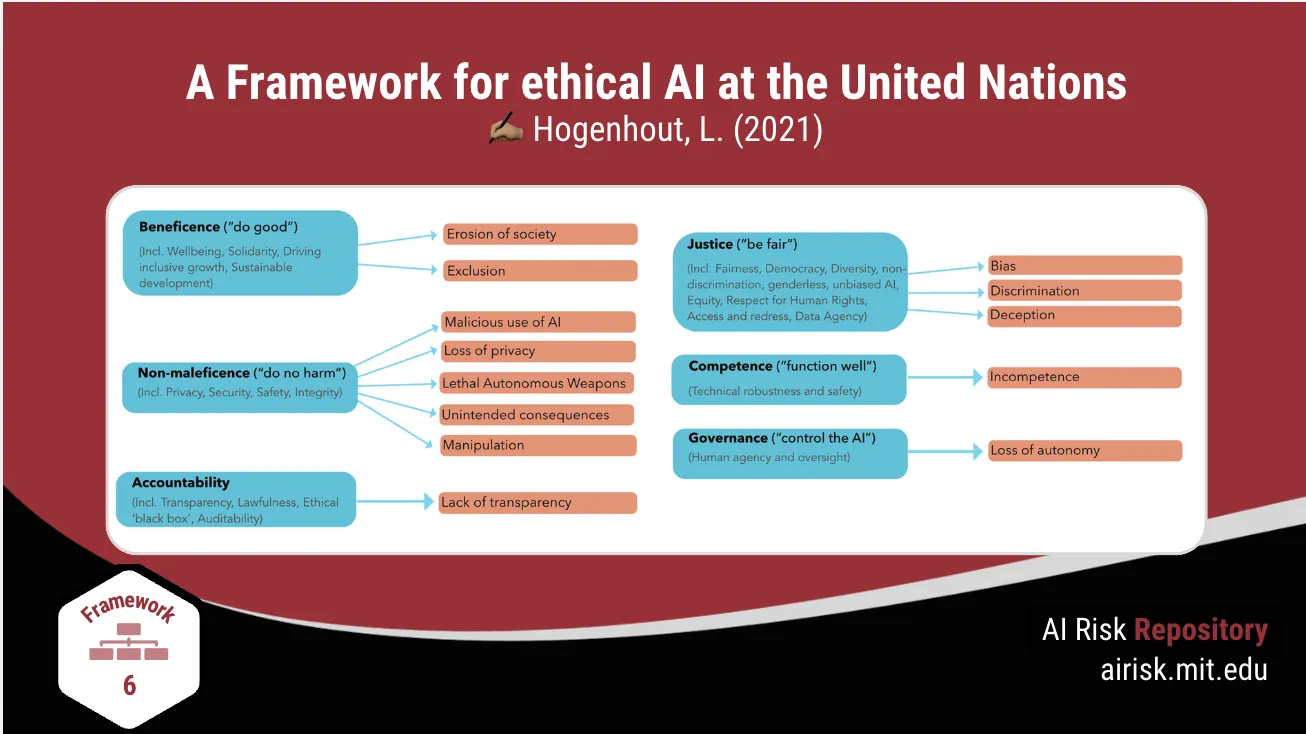
A summary of "A framework for ethical AI at the United Nations" by Lambert Hogenhout.
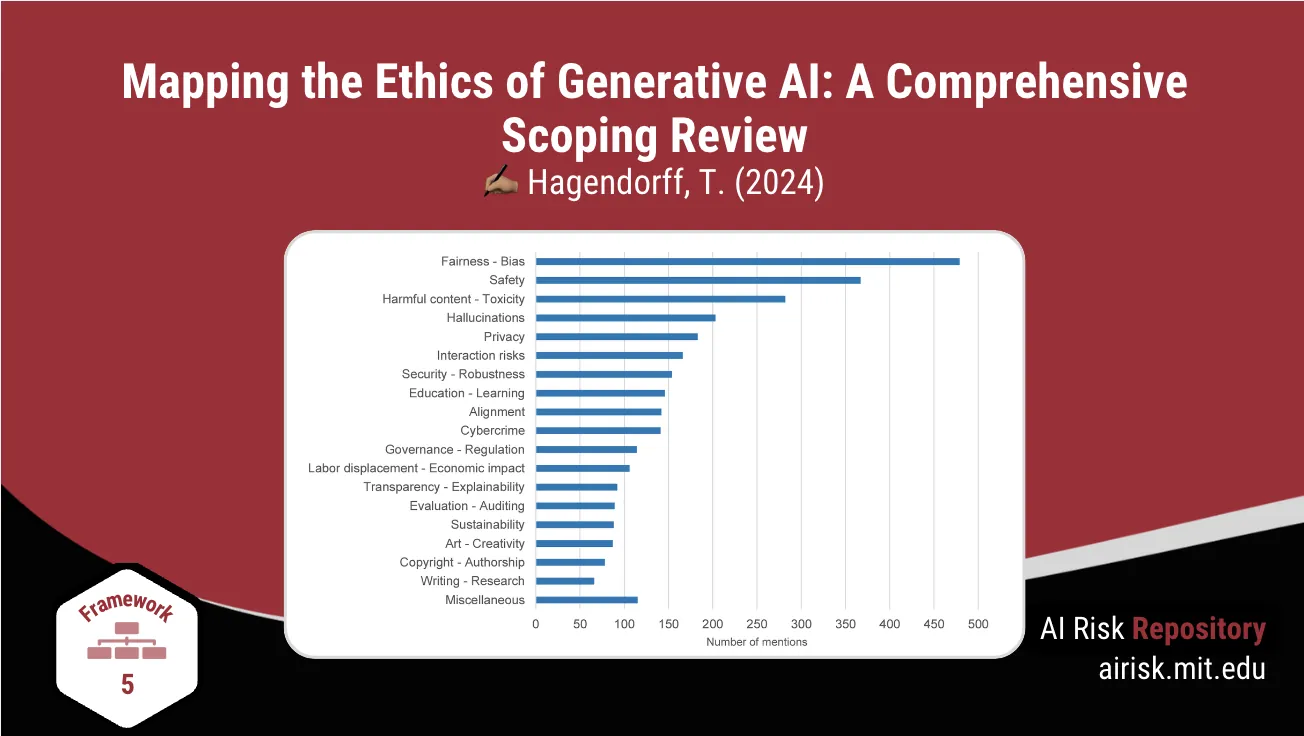
A summary of “A framework for ethical AI at the United Nations” by Thilo Hagendorff.
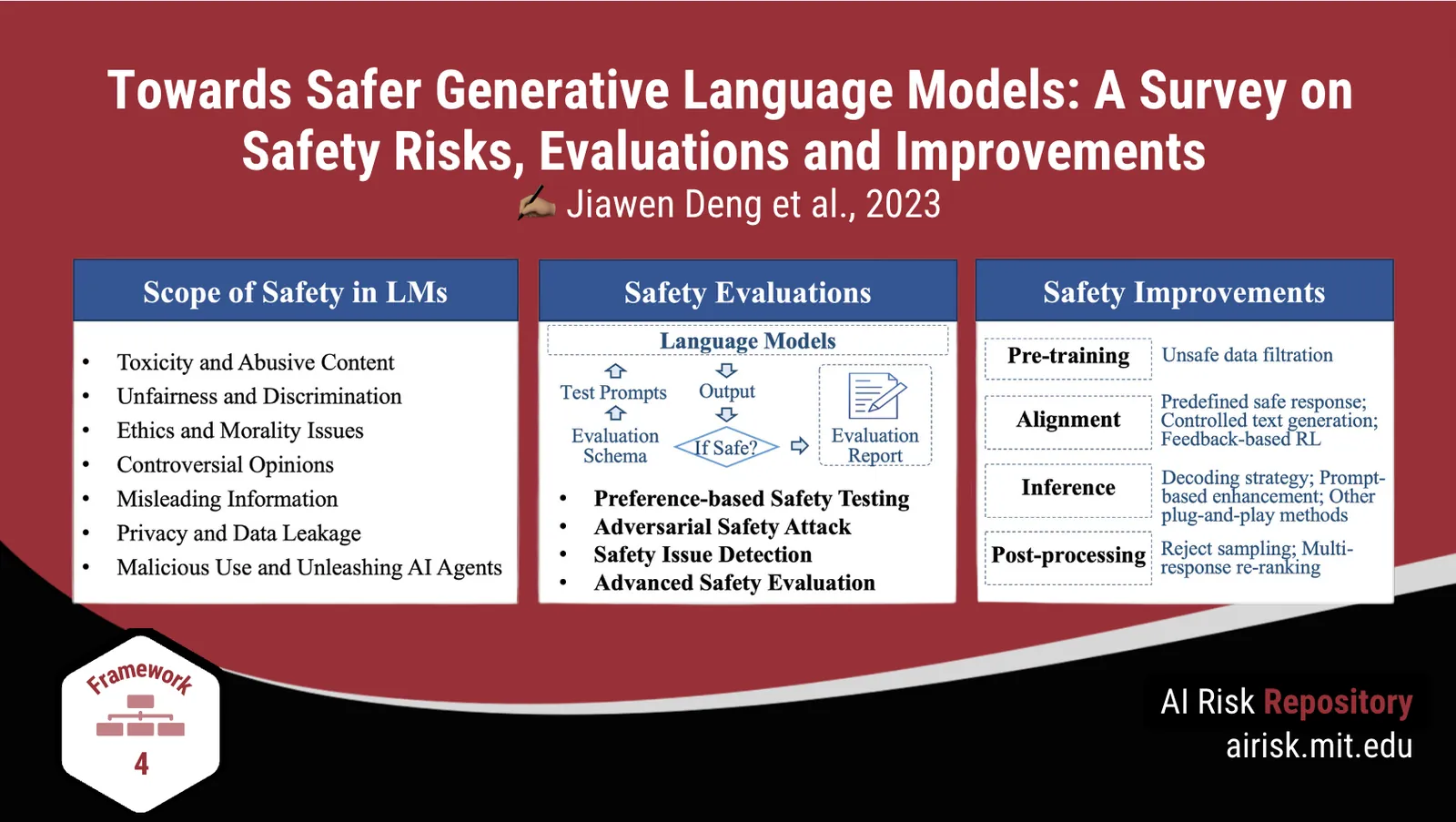
A summary of “Towards Safer Generative Language Models: A Survey on Safety Risks, Evaluations, and Improvements” by Jiawen Deng, Jiale Cheng, and co-authors.
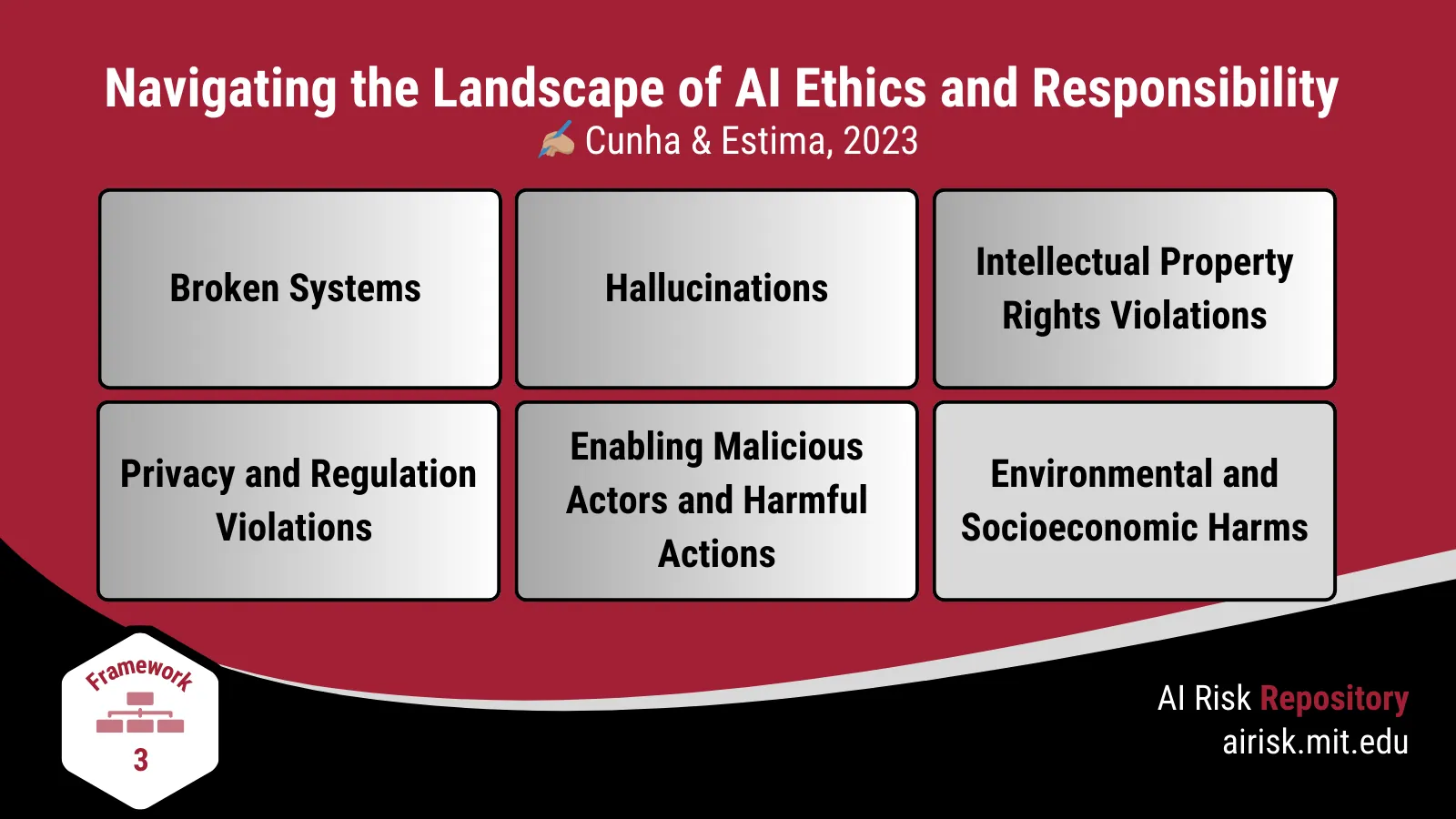
A summary of “Navigating the Landscape of AI Ethics and Responsibility”, by Paulo Rupino Cunha and Jacinto Estima (2023).
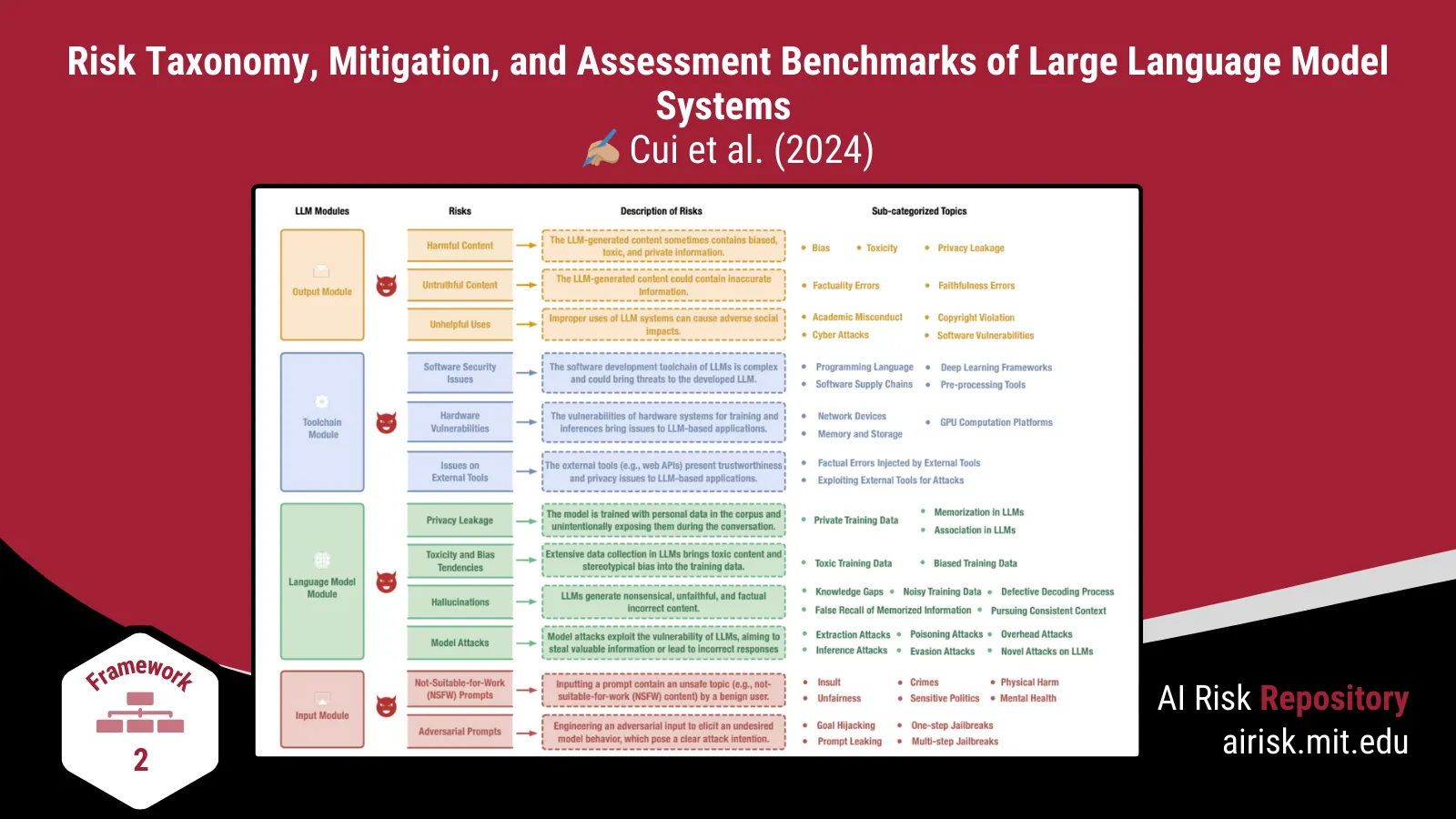
A summary of "Risk Taxonomy, Mitigation, and Assessment Benchmarks of Large Language Model Systems", by Tianyu CUI and colleagues (2024).
A summary of “TASRA: A Taxonomy and Analysis of Societal-Scale Risks from AI” by Andrew Critch and Stuart Russell (2023).
We work with governments, companies, and researchers to build better tools for understanding AI risk. Subscribe to our newsletter for updates. Get in touch to explore partnership opportunities.

.avif)