AI Incident Tracker

Risk Classification Overview

Insights

Domain taxonomy:

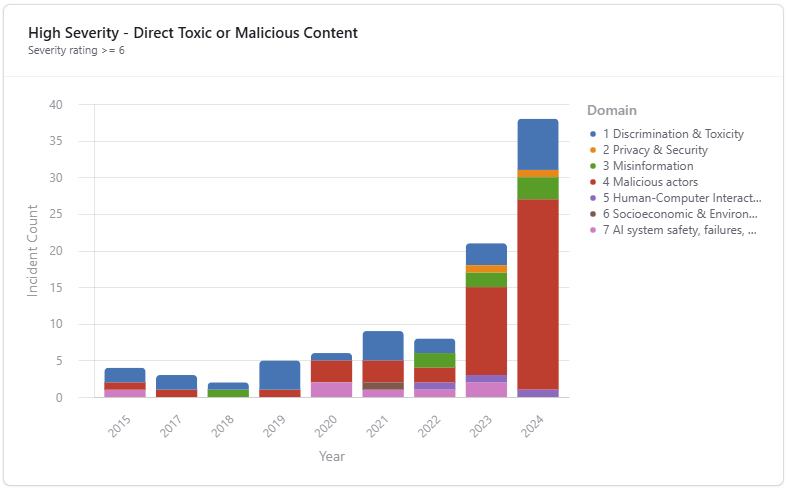
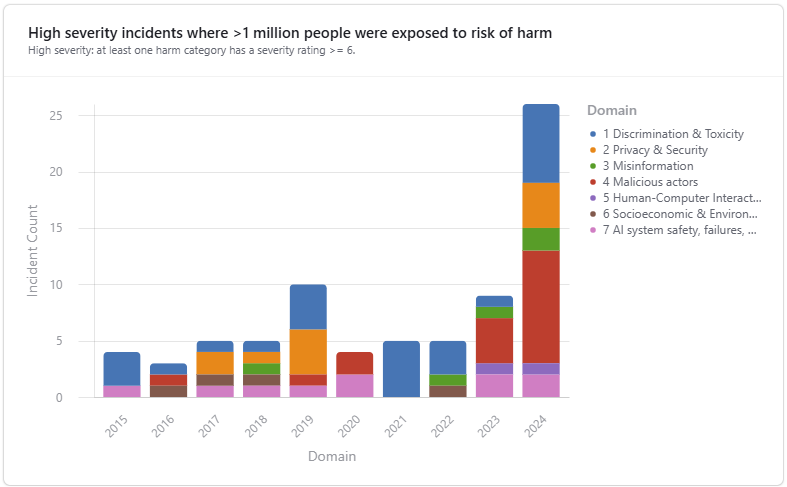
  • The domain with most reported incidents across the full dataset is '4 Malicious actors' (35%) followed by ‘7 AI system safety, failures, & limitations’ (22%)
  • For risks reported in 2025, the proportion of incidents attributed to malicious actors is much higher at 57%
  • Within domain 4, the vast majority of reported incidents (329 of 426) were in the subdomain ‘4.3 Fraud, scams and targeted manipulation’

Causal taxonomy:

  • 51% of reported incidents were tagged as intentionally caused.
  • Almost all reported incidents have been classified as post-deployment, with only 2% pre-deployment

EU AI Act Risk Classification:

  • 3% of reported incidents would be classed as level 1 (Unacceptable) and therefore prohibited under the EU AI Act. 35% would be classified as level 2 (High Risk)

AI System Primary Purpose

  • The primary purpose category attributed to the highest number of incidents is Deepfake Video Generation

Interactive

This interactive shows how incidents in the AI Incident Database are classified using the MIT AI Risk Repository’s causal and domain taxonomies, along with risk levels defined by the EU AI Act.

Explore more of the AI Incident Tracker Project

You can explore different views of the database and classification in the project. For example, you can see all AI incidents classified using taxonomies from the MIT Risk Repository, the type of harm, and individual records in the AI Incident Database.

Key visualizations include bar charts and pie charts that display incident counts, proportions across domains (e.g., "System Failures," "Discrimination & Toxicity"), and trends in causal attributes. Additionally, insights highlight patterns such as the prevalence of system safety issues, intentional misuse trends, and incomplete reporting gaps.

Click through the links below to explore each of the interactive dashboards.

Thank you! Your submission has been received!
Oops! Something went wrong while submitting the form.